Skip to content
Last updated: August 2026. Human written and fact checked against each named source.
Burglary in Ireland has fallen further and faster than almost anywhere else in Europe, yet more than 8,000 homes are still broken into every year, and over half of those break-ins come through a door. This page gathers the current burglary and home security statistics for Ireland in one place: how many burglaries happen, when and how burglars get in, who is most at risk, and how Ireland compares with the rest of the EU, with every figure linked to its primary source.
Key Burglary Statistics for Ireland at a Glance
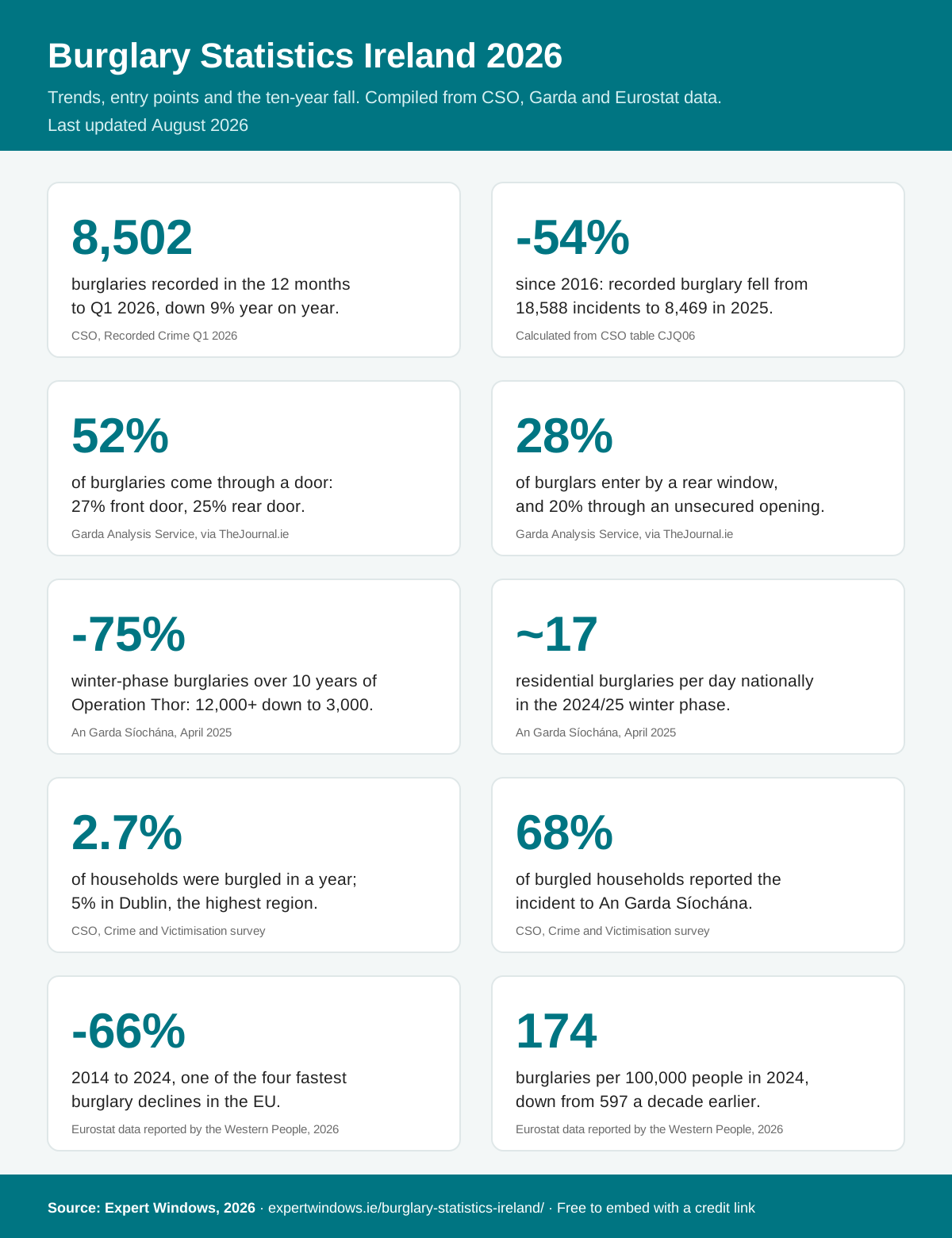
- There were 8,502 burglary and related offences recorded in the twelve months to Q1 2026, down 9% year on year. Source: CSO, Recorded Crime Q1 2026
- Recorded burglary has fallen 54% since 2016, from 18,588 incidents to 8,469 in 2025. Calculated from CSO table CJQ06
- Burglary fell 13% between 2024 and 2025, from 9,747 to 8,469 recorded incidents. Calculated from CSO table CJQ06
- Ireland’s burglary rate dropped 66% between 2014 and 2024, from 597 to 174 offences per 100,000 people, one of the four fastest falls in the EU. Source: Eurostat data reported by the Western People, August 2026
- Winter-phase residential burglaries have fallen 75% in the ten years of Operation Thor, from over 12,000 in 2014/15 to just over 3,000 in 2024/25. Source: An Garda Síochána, April 2025
- 27% of burglars enter through the front door and 25% through a rear door, meaning over half of break-ins come through a door. Source: Garda Analysis Service research reported by TheJournal.ie
- A rear window is the entry point in 28% of burglaries, and 20% of intruders enter through an unsecured door or window. Source: Garda Analysis Service research reported by TheJournal.ie
- 2.7% of Irish households were victims of burglary or attempted burglary in a twelve-month period, rising to 5% in Dublin. Source: CSO, Crime and Victimisation 2019
- 68% of burgled households reported the incident to An Garda Síochána. Source: CSO, Crime and Victimisation 2019
- Residential burglaries across the EU fell 38.1% between 2014 and 2024, to 721,876 recorded offences. Source: Eurostat, August 2026
How Many Burglaries Happen in Ireland
The CSO’s Recorded Crime release for Q1 2026, published on 25 June 2026, counted 8,502 burglary and related offences in the twelve months to the end of March 2026. That was a fall of 9% on the previous twelve months, one of the largest decreases across the fifteen offence groups, behind only homicide and sexual offences. Over the four years from the year to Q1 2023, burglary fell 8%.
The annual series from the CSO’s recorded crime table shows how steep the longer fall has been. Summed across all Garda divisions from table CJQ06, recorded burglary and related offences ran at 18,588 incidents in 2016 and 16,751 in 2019, collapsed to 8,586 during the restricted year of 2021, edged back up to 9,747 by 2024, and then fell 13% to 8,469 in 2025, the lowest full-year figure in the series apart from the pandemic trough. Put simply, burglary in Ireland has more than halved since 2016.
Spread across the year, the 2025 figure works out at roughly 23 burglaries per day nationally, a number that would have been closer to 51 per day in 2016. These daily rates are calculated from the same CSO table.
| Year | Recorded burglary and related offences |
|---|---|
| 2016 | 18,588 |
| 2019 | 16,751 |
| 2020 | 10,886 |
| 2021 | 8,586 |
| 2022 | 9,461 |
| 2023 | 9,569 |
| 2024 | 9,747 |
| 2025 | 8,469 |
Annual totals calculated by Expert Windows from CSO table CJQ06, summed across all Garda divisions. The pandemic years cut burglary sharply as homes were occupied around the clock, and the partial rebound of 2022 to 2024 has now given way to a fresh decline.
Burglary’s decline also stands out against other property crime. In the same four-year comparison, theft and related offences moved the opposite way, rising 8% to 74,641 incidents in the year to Q1 2026, while damage to property fell 7% to 20,578. Burglary is the property crime Ireland has most successfully suppressed.
The Winter Pattern and Operation Thor
Burglary in Ireland is seasonal. Garda research has long shown that residential burglaries increase between 5pm and 10pm during winter, when darkness shows which homes are empty. An Garda Síochána has run Operation Thor against this winter pattern every year since 2015, and its April 2025 update reports the cumulative effect: winter-phase residential burglaries (October to March) have dropped 75% in ten years, from over 12,000 in the 2014/15 phase to just over 3,000 in 2024/25.
The same Garda statement puts the 2024/25 winter phase at an average of approximately 17 residential burglaries per day across the 26 counties, with December 2024 the lowest December in five years and March 2025 the lowest month since 2021. Q1 2025 recorded residential burglaries were down 19% on Q1 2024. Enforcement was part of that: the winter phase produced over 900 arrests and over 2,000 charges linked to burglary, aggravated burglary or possession of an article.
How Burglars Get In
Research by the Garda Analysis Service, reported by TheJournal.ie, breaks down the entry points used in Irish residential burglaries:
| Entry point | Share of burglaries |
|---|---|
| Rear window | 28% |
| Front door | 27% |
| Rear door | 25% |
| Unsecured door or window | 20% |
Two things stand out from those figures. Combining the front and rear door shares, 52% of burglaries come through a door, which is why door strength, locking points and glazing matter more than any other single element of home security. And one in five intruders does not force anything at all: they come through a door or window that was left unsecured, the cheapest vulnerability in the country to fix.
Who Gets Burgled
The CSO’s Crime and Victimisation survey, the most recent household-level measure, found that 2.7% of Irish households had been victims of burglary or attempted burglary in the twelve months before interview. Dublin households were the most exposed at 5%, while the Border and West regions recorded the lowest household crime rates at 2%. Households in the most disadvantaged areas and the most affluent areas were both more likely to experience household crime than those in between, at 5% each.
Not every burglary reaches the official figures. The survey found that 68% of burgled households reported the incident to An Garda Síochána, a higher reporting rate than for vandalism at 53%, but one that still means roughly one burglary in three never appears in the recorded crime statistics. The most common reason given for not reporting was that the victim did not consider the incident serious enough or had suffered no loss.
Detection and Outcomes
The CSO’s Recorded Crime Detection release for 2024, published in November 2025, shows what happens after a burglary is reported. At least 20% of burglary and related offences reported in each year from 2020 to 2024 led to a charge or summons, an improvement on the 15% to 16% recorded for 2018 and 2019. Where a burglary was marked as detected, the suspected offender was male in 90% of cases, one of the highest male shares of any offence group, and most suspected offenders across all detected crime in 2024 were aged between 18 and 44.
How Ireland Compares With the EU
Ireland’s fall in burglary is part of a European trend, but a much sharper version of it. Eurostat reported in August 2026 that residential burglaries across the EU dropped 38.1% between 2014 and 2024, from 1.17 million to 721,876 recorded offences.
Ireland beat that average by a wide margin. Eurostat figures reported by the Western People show Irish burglaries down 66% over the same decade, from roughly 27,700 cases to just over 9,300, with the rate per 100,000 people falling from 597 to 174. Only Bulgaria, Lithuania, Greece and the Netherlands recorded faster declines, and Ireland’s EU ranking improved from 8th highest to 13th. The improvement has continued since the comparison year: the CSO’s 2025 figure of 8,469 is a further 13% below 2024.
What the Numbers Mean for Home Security
The entry-point data is the practical core of these statistics. With 52% of burglaries coming through a door and 28% through a rear window, the highest-value security upgrades are the ones that harden those routes: solid door construction, multi-point locking, laminated or toughened glazing, and window locks that are actually used. The 20% of burglaries that need no force at all are a reminder that hardware only works when it is engaged, a point An Garda Síochána repeats through every winter phase of Operation Thor.
The falling national numbers do not fall evenly, either. A Dublin household’s 5% annual burglary risk in the CSO survey is roughly twice the national average, so the case for securing doors and windows is strongest exactly where most of Ireland’s housing is concentrated. Ireland’s homes are also ageing, and older doors and windows generally predate modern locking and glazing standards; our home energy efficiency statistics page shows that 65% of occupied Irish homes were built before 2001.
Method and Sources
The figures on this page were compiled in August 2026 from the Central Statistics Office (Recorded Crime Q1 2026, published 25 June 2026; recorded crime table CJQ06; and the Crime and Victimisation survey 2019), An Garda Síochána (Operation Thor winter phase 2024/25 statement, 13 April 2025), Eurostat (news release of 3 August 2026), Garda Analysis Service entry-point research as reported by TheJournal.ie (October 2019), and Eurostat data as reported by the Western People (16 August 2026). Annual and daily burglary figures described as calculated were summed by Expert Windows across all Garda divisions from CSO table CJQ06, and the combined door-entry share was calculated from the Garda Analysis Service percentages. Every figure was checked against its source before publication, and the page will be updated when the CSO publishes its next quarterly recorded crime release.
How Expert Windows Helps
More than half of Irish burglaries come through a door, and doors are what we fit every day. Expert Windows supplies and installs secure front doors, composite doors and steel doors with multi-point locking across Dublin and the surrounding counties, along with modern glazed windows that replace the older units burglars target. If you are reviewing your home’s weak points, contact us for a survey and a quotation.