Skip to content
Last updated: August 2026. Human written and fact checked against each named source.
Ireland’s housing stock is old, and most of it was built long before today’s energy standards. That shapes how much heat Irish homes lose, how much households spend to stay warm, and why the Government is now paying homeowners to replace their windows and doors. This page gathers the most current home energy efficiency statistics for Ireland, covering Building Energy Ratings, retrofit progress, grant uptake and energy poverty in one place, with every number linked to its primary source, so that journalists, researchers and homeowners can cite them with confidence.
Key Home Energy Efficiency Statistics for Ireland at a Glance
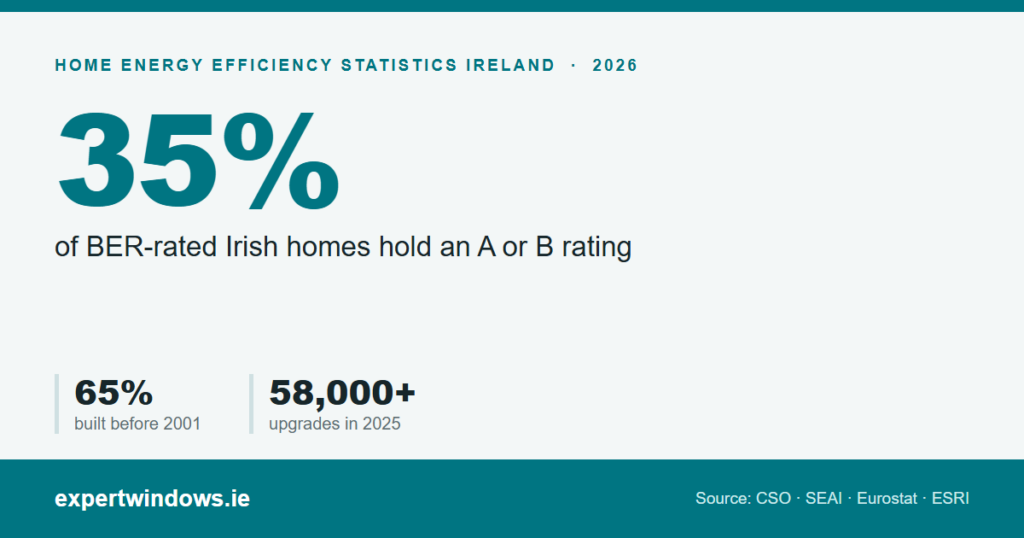
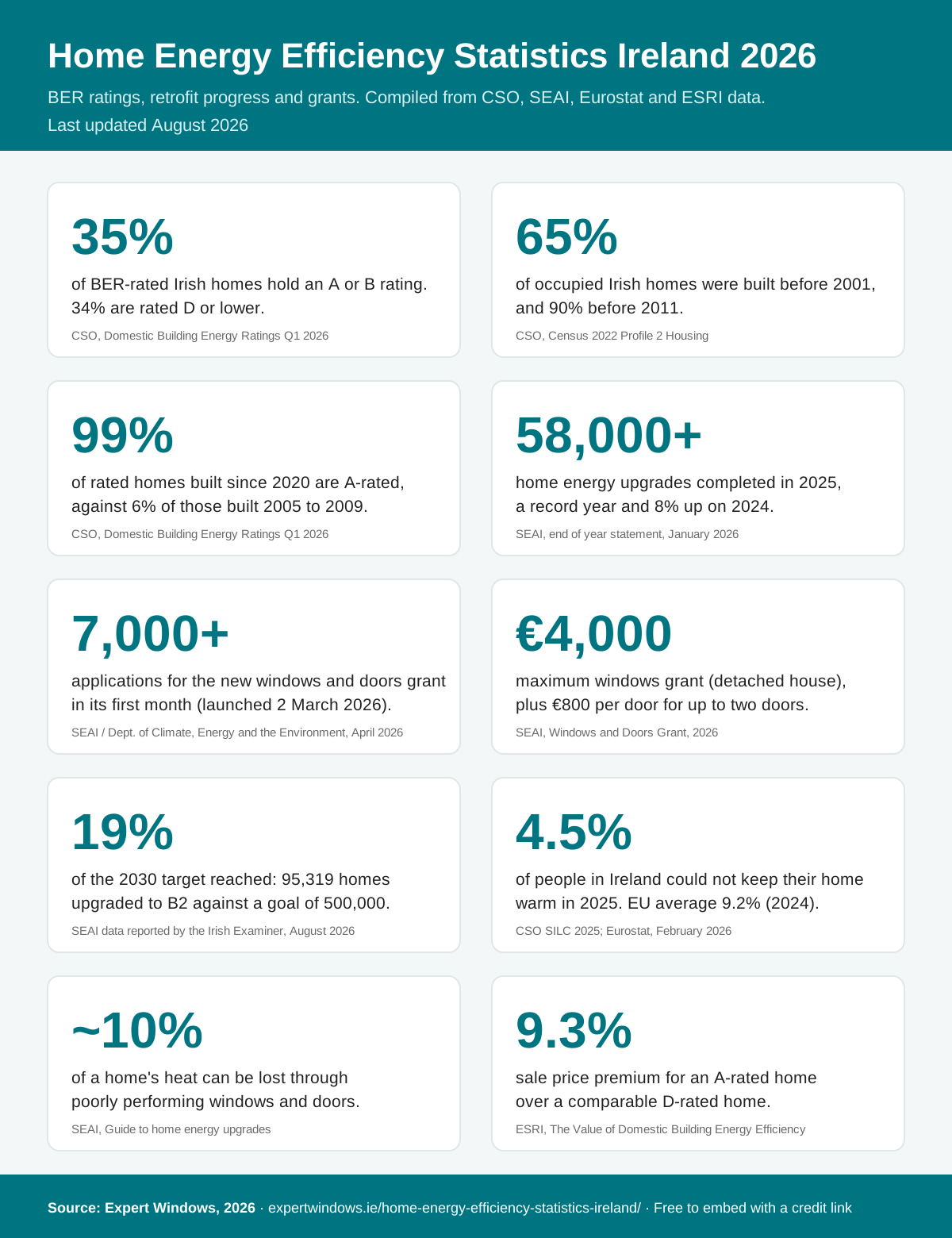
- Over one third (35%) of Irish homes with a Building Energy Rating hold an A or B rating, while 34% are rated D or lower. Source: CSO, Domestic Building Energy Ratings Q1 2026
- 1.35 million unique dwellings have received a BER since 2009, roughly 64% of the 2,112,121 homes counted in Census 2022. Sources: CSO BER Q1 2026; CSO Census 2022
- 65% of occupied Irish homes were built before 2001, and 90% before 2011. Source: CSO Census 2022, table FY033A
- 99% of rated homes built since 2020 are A-rated, compared with just 6% of those built between 2005 and 2009. Source: CSO, 2026
- Over 58,000 home energy upgrades were completed through SEAI schemes in 2025, a record year and 8% more than 2024. Source: SEAI, January 2026
- More than 7,000 homeowners applied for the new SEAI windows and doors grant within a month of its launch on 2 March 2026. Source: SEAI, April 2026
- The windows grant ranges from €1,500 for an apartment to €4,000 for a detached house, plus €800 per external door for up to two doors. Source: SEAI Windows and Doors Grant
- 95,319 homes had been upgraded to a B2 rating by the end of July 2026, about 19% of the 500,000 target for 2030. Source: SEAI data reported by the Irish Examiner, August 2026
- 4.5% of people in Ireland were unable to keep their home adequately warm in 2025, against an EU average of 9.2% in 2024. Sources: CSO SILC 2025; Eurostat, February 2026
- A home can lose about 10% of its heat through poorly performing windows and doors. Source: SEAI guide to home energy upgrades
How Many Irish Homes Have a BER and What They Score
A Building Energy Rating is required whenever a home is sold or rented, so the national BER register is the best available picture of how efficient Irish housing really is. According to the CSO’s Domestic Building Energy Ratings release for Q1 2026, published on 1 May 2026, almost 1.8 million BER audits have been published since 2009, covering 1.35 million unique dwellings. Set against the 2,112,121 permanent dwellings recorded in Census 2022, that means roughly 64% of Irish homes have been rated at least once, while about a third have never been assessed.
Of those 1.35 million rated dwellings, 18% were rated A, 17% rated B and 31% rated C. The remaining 34% were rated D, E, F or G. Put another way, almost two in every three rated homes fall below the B2 standard that Government policy treats as the benchmark for a properly retrofitted house.
The register is also growing quickly. The CSO recorded 40,961 new domestic BER audits in the first quarter of 2026 alone, 9% more than in the same quarter of 2025.
Among dwellings assessed more than once, 220,096 improved by at least one full letter between their first and latest rating, and 51% of those moved from a C or lower to an A or B. That is the clearest national measure of retrofit activity actually showing up in the housing stock.
Energy Ratings by Age of Home
Age is the single strongest predictor of a home’s rating. The CSO data shows that A ratings were awarded to 100% (rounded) of rated dwellings built from 2025 onwards, 99% of those built between 2020 and 2024 and 94% of those built between 2015 and 2019. The picture changes sharply for older stock: only 38% of dwellings built between 2010 and 2014 and 6% of those built between 2005 and 2009 have received an A rating.
That matters because Ireland’s housing is old. Census 2022 counted 1,836,728 occupied dwellings, and the CSO’s year-built breakdown (table FY033A) shows that 1,200,514 of them, or 65%, were built before 2001. A further 450,817 were built between 2001 and 2010, so around 90% of all occupied homes predate 2011. Only 142,288 occupied dwellings, under 8% of the total, were built in 2011 or later, the period in which near-universal A ratings became the norm.
The oldest cohorts are large. Census 2022 recorded 154,290 occupied dwellings built before 1919 and 224,733 built in the 1970s, more than in any earlier decade and all of it predating modern building regulations on insulation and glazing.
Where Ireland’s Most and Least Efficient Homes Are
The CSO’s county breakdown shows a clear east-west divide. The highest proportions of A-rated dwellings were in Kildare (30%), Meath (28%) and Dublin County (28%), reflecting the concentration of recent housebuilding in the commuter belt. The lowest shares were in Leitrim (6%) and Cork City (6%). The highest proportions of G-rated homes, the lowest possible band, were in Roscommon (11%) and Leitrim (11%).
Within Dublin, the postal districts with the most A ratings were Dublin 18 (44%), Dublin 13 (31%) and Dublin 20 (27%).
The average floor area of a rated dwelling was 118 square metres. Detached houses averaged 168 square metres, while basement apartments were the smallest type at 63 square metres.
How Irish Homes Are Heated
Mains gas and heating oil each heat 34% of rated dwellings, with electricity at 25%. The split is strongly regional: gas heats 61% of rated homes in Dublin and 39% in the Mid-East, while oil dominates outside the capital, heating 67% of rated homes in the Border region, 60% in the West and around half in the Midlands, Mid-West and South-East. By county, oil heating was most common in Donegal (72%), Mayo (68%) and Roscommon (67%), while mains gas was most common in Cork City (70%) and Dublin County (62%).
Heating fuel and rating are closely linked. A ratings were given to 53% of dwellings using electricity as their main space heating fuel, but only 8% of gas-heated homes and 2% of oil-heated homes. Heat pumps were present in 15% of all rated dwellings, rising to 84% of those built between 2020 and 2024. Solar energy, either thermal or photovoltaic, was present in 15% of rated dwellings, highest in detached houses (25%) and in Meath (24%), Kildare (22%) and Dublin County (21%).
Retrofit Progress Against the 2030 Targets
Ireland’s Climate Action Plans set two headline residential targets for 2030: upgrading 500,000 existing homes to a B2 rating or better, and installing 400,000 heat pumps in existing homes. SEAI data reported by the Irish Examiner in August 2026 puts progress at 95,319 B2 upgrades by the end of July 2026, around 19% of the target, and 19,583 heat pump installations in existing dwellings between 2020 and July 2026, just under 5% of the target. Dublin (18,548) and Cork (12,647) account for the largest numbers of B2 upgrades.
Delivery is nevertheless accelerating. SEAI’s end-of-year statement for 2025 reported over 58,000 home energy upgrades completed during the year, 8% more than in 2024 and the highest annual total on record, supported by €645 million in Government funding. More than 8,000 homes at risk of fuel poverty received fully funded upgrades under the Warmer Homes Scheme, also a record.
Cumulatively, SEAI reported in April 2026 that 257,000 home energy upgrades have been delivered since 2019, backed by over €1.7 billion in Government funding. Budget 2026 allocated a record €640 million to the programme with a target of 73,000 upgrades in 2026, which would be a 26% increase on the 2025 total.
The 2026 Windows and Doors Grant in Numbers
For the first time, SEAI introduced a standalone grant for replacing windows and external doors on 2 March 2026 as part of the National Residential Retrofit Plan. The grant values depend on the type of home:
| Measure | Grant value |
|---|---|
| Windows, apartment | €1,500 |
| Windows, mid-terrace house | €1,800 |
| Windows, semi-detached or end-of-terrace house | €3,000 |
| Windows, detached house | €4,000 |
| External doors | €800 per door, maximum two doors |
To qualify, the home must have been built and occupied before 2011, the new windows and doors must achieve a U-value of 1.4 W/m²K or better, and the property must already have good attic and wall insulation, evidenced by a Heat Loss Indicator of 2.3 W/K·m² or lower or an advisory report grading the attic and walls as Good or Very Good. A post-works BER is required and is itself grant-aided.
Demand was immediate. SEAI processed 29,000 grant applications in the first quarter of 2026, almost double the same period in 2025, and over 7,000 of those were for the new windows and doors grant, even though it only opened in the final month of the quarter. Applications for individual upgrades overall were up 186% year on year.
Eligibility is narrower than the headline suggests. Analysis reported by TheJournal.ie in March 2026, based on SEAI figures, estimated that up to 350,000 homes, roughly one in six of the national stock, currently meet the insulation criteria. Homes that fall short can apply for SEAI attic and wall insulation grants first, then return for the windows and doors grant. Our guide to window and door grants in Ireland explains the process step by step.
We track the scheme’s uptake in detail, applications, completions and eligibility, on our SEAI windows and doors grant statistics page.
Energy Poverty and Keeping Homes Warm
The CSO’s Survey on Income and Living Conditions 2025 found that 4.5% of people were unable to keep their home adequately warm, down from 4.9% in 2024 but still above the rate recorded in 2021 before the energy price shock. A further 7.5% went without heating at some point in the previous twelve months because of a lack of money, down from 8.2% in 2024 and 8.8% in 2020.
The burden is uneven. One in ten people in rented accommodation (9.9%) could not keep their home adequately warm in 2025, more than four times the rate for owner-occupiers (2.0%). One in four people in single-adult households with children (24.0%) went without heating through lack of money, and 12.5% of that group could not keep their home warm. Among unemployed people the rate was 13.9%, and among those unable to work due to long-standing health problems it was 13.5%.
Ireland compares well with the rest of the EU on this measure. Eurostat reported that 9.2% of the EU population could not keep their home adequately warm in 2024, an improvement of 1.4 percentage points on 2023. Bulgaria and Greece recorded the highest rates (both 19.0%), followed by Lithuania (18.0%) and Spain (17.5%), while Finland (2.7%), Poland and Slovenia (both 3.3%) had the lowest. Ireland’s 2024 figure of 4.9% placed it among the better-performing member states.
Ireland does far worse on damp than on warmth: 21.2% of people lived in a home with damp, leaks or rot in 2023, the fourth highest rate in the EU. See our damp and mould statistics for Ireland.
What a Better Rating Is Worth
Research by the Economic and Social Research Institute, based on over 1.2 million Irish property listings, found that an A-rated home commands a sale price premium of 9.3% over an otherwise comparable D-rated home, and a rental premium of 1.8%.
More recent market data points the same way. A Q2 2026 housing market report by property-data firm Geowox, reported by TheJournal.ie in July 2026, found that existing homes with an A or B rating sold for a 27.3% premium over C to G rated homes, roughly €97,000 at the national median price of €393,000. Because new homes were excluded from that analysis, the gap reflects the value buyers place on efficiency in the second-hand market rather than simply a preference for new builds.
How Much Heat Windows and Doors Lose
SEAI’s guide to home energy upgrades states that a home can lose about 10% of its heat through poorly performing windows and doors, up to 30% through poorly insulated roofs and walls, and up to 10% through uninsulated floors. Window frames typically account for 20% to 30% of the total window area, which is why frame material and design matter as much as the glazing itself.
SEAI recommends windows and doors with a U-value of 1.4 W/m²K or lower, the same threshold required for the grant. In SEAI’s sample BER advisory report, double glazing with an average U-value of 2.7 W/m²K is graded Poor, while 1.4 W/m²K is graded Good. Standard lead times quoted by SEAI are six to ten weeks from order to installation for windows and four to six weeks for doors.
Method and Sources
The figures on this page were compiled in August 2026 from the Central Statistics Office (Domestic Building Energy Ratings Q1 2026, Census 2022 Profile 2 Housing in Ireland, and the Survey on Income and Living Conditions 2025), the Sustainable Energy Authority of Ireland (grant scheme pages and press statements of 8 January, 27 January and 21 April 2026), Eurostat (2 February 2026), the Economic and Social Research Institute, and SEAI data as reported by the Irish Examiner (10 August 2026) and TheJournal.ie (28 March and 25 July 2026). Percentages described as derived, such as the share of homes built before 2001 or the share of the 2030 target achieved, were calculated by Expert Windows from the cited source tables. Every figure was checked against its source before publication, and the page will be updated when the CSO publishes its next quarterly BER release and when SEAI publishes its 2026 retrofit reports.
How Expert Windows Helps
Most Irish homes were built before modern glazing standards, and the 2026 grant is the first standalone SEAI support for replacing windows and doors. Expert Windows supplies and fits double glazed and triple-pane windows and energy-efficient external doors across Dublin and the surrounding counties, and can advise on the U-values and certification the grant requires. If you are weighing up a window replacement and want to know whether your home is likely to qualify, contact us for a survey and a quotation.