Skip to content

Last updated: October 2026. Human written and fact checked against each named source.
Irish fire brigades attended 21,794 fires in 2025, and 4,131 of them were in people’s homes. Thirty-four people died in fires during the year, the highest number since 2017. This page gathers the current statistics on house fires and fire safety in Ireland in one place: how many home fires there are, the ten-year trend in fire deaths, who is most at risk, where fatal fires start, how often smoke alarms were working, and what the building regulations say about escape windows, with every figure linked to its primary source.
Key House Fire Statistics for Ireland at a Glance
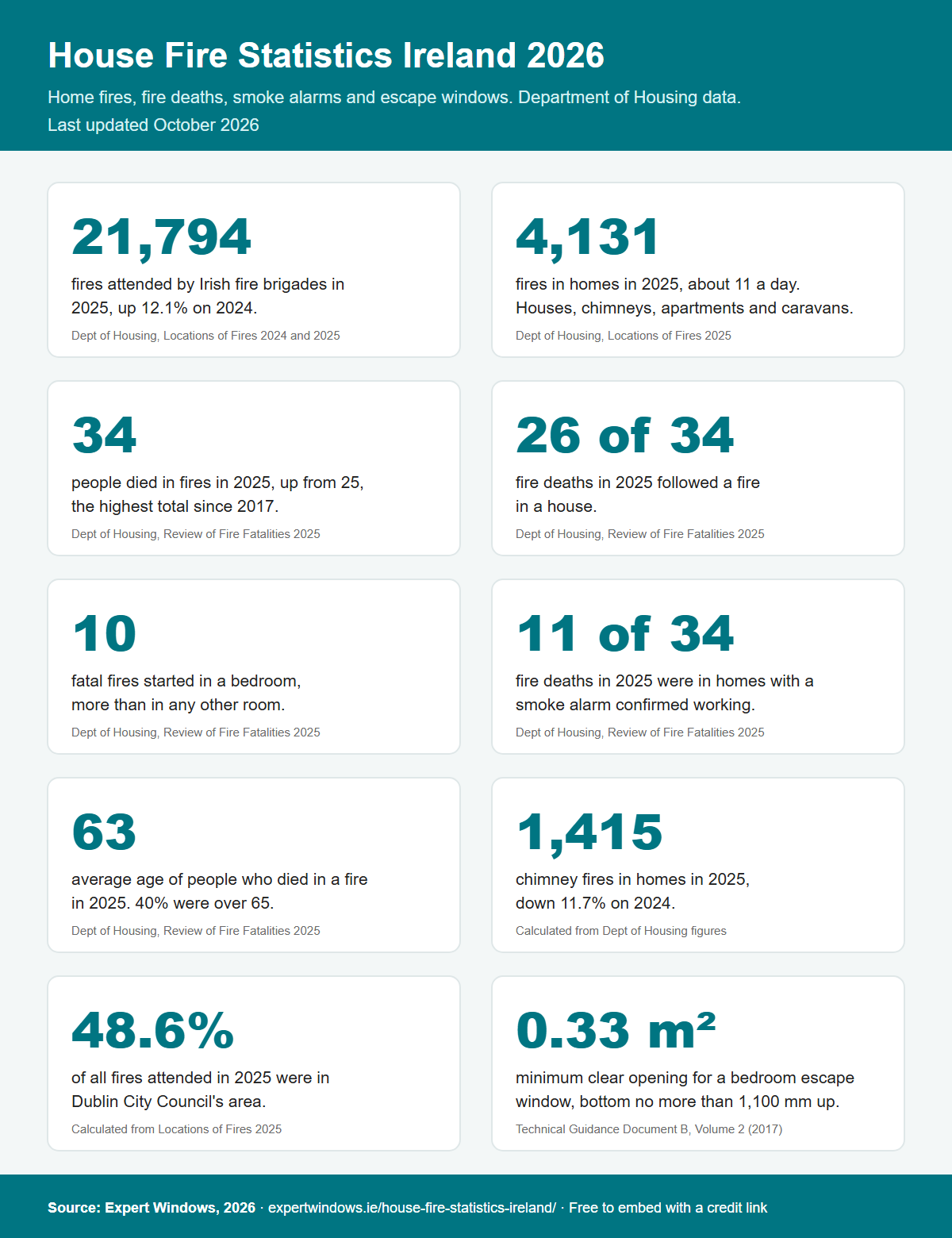
- Fire brigades attended 21,794 fires in Ireland in 2025, up 12.1% on the 19,441 attended in 2024. Source: Department of Housing, Locations of Fires Statistics 2024 and 2025 (change calculated)
- 4,131 of those fires were in homes: houses, chimneys, apartments and caravans. That is about 11 home fires a day. Source: Locations of Fires 2025 (daily rate calculated)
- 34 people died in fires in 2025, up from 25 in 2024, an increase of 36% and the highest total since 42 deaths in 2017. Source: Department of Housing, Review of Fire Fatalities 2025
- 26 of the 34 people who died were in a house fire, and 3 more died in apartments. Source: Review of Fire Fatalities 2025
- The bedroom was the room of origin in 10 fatal fires, more than any other room. Source: Review of Fire Fatalities 2025
- A working smoke alarm was confirmed in the homes of just 11 of the 34 people who died in 2025. Source: Review of Fire Fatalities 2025
- The average age of people who died in a fire in 2025 was 63, 40% were over 65, and 26 of the 34 were men. Source: Review of Fire Fatalities 2025
- Smoking was the leading known cause of fatal fires, linked to 6 deaths. Source: Review of Fire Fatalities 2025
- Fire brigades attended 1,415 chimney fires in homes in 2025, down 11.7% on 2024. Source: Locations of Fires Statistics (change calculated)
- Building guidance says every bedroom window used for escape should open to a clear area of at least 0.33 m², with the bottom of the opening no more than 1,100 mm above the floor. Source: Technical Guidance Document B, Volume 2
How Many Fires Happen in Irish Homes
The Department of Housing, Local Government and Heritage publishes a count of every fire attended by the 27 local authority fire services, broken down by the type of building or place. In 2025 the services attended 21,794 fires, according to its Locations of Fires 2025 table, up from 19,441 in the 2024 table.
Homes accounted for 4,131 of those fires, or 19.0% of the total, calculated from the same table. That is about 11 home fires every day. The number of home fires barely moved between the two years, rising by 36, but the mix changed: chimney fires fell while other fires in houses rose by 10.8%.
| Home fire type | 2024 | 2025 | Change (calculated) |
|---|---|---|---|
| Chimney fires in houses | 1,603 | 1,415 | -11.7% |
| Other house fires | 2,219 | 2,459 | +10.8% |
| Apartments, flats and bedsitters | 209 | 195 | -6.7% |
| Caravans and mobile homes | 64 | 62 | -3.1% |
| All home fires | 4,095 | 4,131 | +0.9% |
Source: Department of Housing, Locations of Fires Statistics, 2024 and 2025. Changes and totals calculated by Expert Windows.
Chimney fires come from homes heated by open fires and solid fuel stoves. Which fuels Irish homes use, and what each one costs, is covered on our home heating costs statistics page.
Fire Deaths in Ireland: The Ten-Year Trend
The Department’s Review of Fire Fatalities 2025 records 34 fire-related deaths in 32 fatal fire incidents during 2025, an increase of seven incidents and nine deaths on 2024. The report puts the 2025 rate at 6.2 fire deaths per million people and the three-year average at 4.7 per million, and says Ireland remains among the countries that have limited fire deaths successfully.
| Year | Fire deaths |
|---|---|
| 2015 | 41 |
| 2016 | 20 |
| 2017 | 42 |
| 2018 | 18 |
| 2019 | 16 |
| 2020 | 29 |
| 2021 | 20 |
| 2022 | 19 |
| 2023 | 17 |
| 2024 | 25 |
| 2025 | 34 |
Source: Department of Housing, Review of Fire Fatalities 2025, ten-year trend. The 2020, 2023 and 2024 figures were checked against the Department’s annual fire fatality files.
Annual totals swing widely, so a single year says little on its own. Over the ten years from 2015 to 2024 the average was 24.7 deaths a year, calculated from the table above, which puts 2025 about 38% above the decade’s norm. The two years since 2023 have both risen, from 17 to 25 to 34.
The timing was also unusual. Fire deaths in Ireland are normally higher in winter, but the 2025 review notes that seven deaths were recorded in June.
Who Dies in House Fires
Older people carry most of the risk. The average age of those who died in a fire in 2025 was 63, and 40% were over 65, according to the 2025 review. The largest single age group was people in their sixties, with 10 deaths. The Department links the pattern to reduced mobility and living alone.
The same pattern runs through earlier years. The average age of fire victims was 69 in 2024 and 66 in 2023, according to the Department’s 2024 and 2023 fatality files, and 18 of the 29 people who died in 2020 were aged 65 or over, according to the 2020 file.
Men were far more likely to die. In 2025, 26 of the 34 people who died were men and 8 were women.
Where and How Fatal Fires Start
Most fatal fires happen at home. Of the 34 deaths in 2025, 26 followed fires in houses, 3 in apartments, 2 in domestic garages, 1 in a bedsit and 2 outdoors, according to the 2025 review. Deaths were spread evenly between the countryside and towns: 14 in rural areas, 13 in urban areas and 7 in villages.
The bedroom was the most common room where a fatal fire started, with 10 cases, followed by the living room and the kitchen with 6 each. The Department notes that bedrooms carry a higher risk because people may be asleep for long periods and bedding can help a fire develop quickly. In 5 cases the fire service could not determine where the fire began.
Smoking was again the leading known cause, with cigarettes the suspected cause in 6 deaths. Arson, solid fuel appliances, cooking appliances and electrical appliances were each linked to 2 deaths, the use of an accelerant and the burning of refuse to 1 each, and 5 were under Garda investigation. In 13 cases the cause could not be determined. These causes are the fire service’s professional judgement at the scene rather than the result of a forensic examination.
Smoke Alarms: Present but Not Always Working
Smoke alarms are the main early warning in a home fire, yet they were often missing or not working in fatal fires. In 2025 a smoke alarm was confirmed present in 14 of the 34 cases and confirmed working in only 11, according to the 2025 review. In the remaining cases the alarm was absent, not applicable, unknown, or impossible to assess because of fire damage.
| Year | Fire deaths | Smoke alarm confirmed present | Smoke alarm confirmed working |
|---|---|---|---|
| 2023 | 17 | 8 | 1 |
| 2024 | 25 | 10 | 8 |
| 2025 | 34 | 14 | 11 |
| 2023 to 2025 | 76 | 32 (42%) | 20 (26%) |
Source: Department of Housing fire fatality statistics, 2023, 2024 and 2025. Three-year totals and percentages calculated by Expert Windows.
Across the three years, a working smoke alarm was confirmed in the homes of about one in four people who died in a fire. The National Directorate for Fire and Emergency Management advises having at least one smoke alarm on every level of the home, making sure it can be heard from the bedrooms, testing it weekly and checking its expiry date. Its Community Smoke Alarm Scheme, funded by the Department of Housing, provides free alarms to vulnerable households through the local fire service.
What Causes Fires Across Ireland
The Department also records the suspected cause of every fire attended, although Dublin City Council does not record causes, so these figures cover the rest of the country. Outside Dublin, fire services attended 11,210 fires in 2025, and the cause was unknown in 6,984 of them, or 62.3%, calculated from the Causes of Fires 2025 table.
| Suspected cause, 2025 (outside Dublin) | Fires | Share of fires with a known cause (calculated) |
|---|---|---|
| Malicious | 1,074 | 25.4% |
| Chimneys, flues, soot and hot ashes | 1,041 | 24.6% |
| Rubbish burning | 707 | 16.7% |
| Electrical equipment and wiring | 386 | 9.1% |
| Cooking and heating | 196 | 4.6% |
| Smoking materials, matches and lighters | 204 | 4.8% |
Source: Department of Housing, Causes of Fires Statistics 2025. Covers all fires attended, not only home fires. Shares calculated against the 4,226 fires with a known cause; other causes are not shown.
Chimneys, flues, soot and hot ashes were the largest accidental cause, which matches the 1,415 chimney fires in homes recorded in the locations table. Electrical equipment and wiring together accounted for 386 fires.
Fires Across the Country
Most fires attended in Ireland are not in buildings at all. Outdoor rubbish was the single largest category in 2025, with 6,778 fires, followed by forest, bog and grass fires at 2,314, nearly double the 1,192 recorded in 2024, and motor vehicle fires at 2,204, according to the Locations of Fires tables. Fire brigades also answered 8,573 false fire alarms during the year, according to Department figures reported by the Irish Examiner.
Dublin dominates the national count. Dublin City Council, which runs Dublin Fire Brigade, recorded 10,599 fires in 2025, or 48.6% of all fires attended in Ireland, and 1,046 fires in homes, a quarter of the national total, calculated from the 2025 locations table. Fire deaths were spread more widely: 20 local authority areas recorded at least one in 2025, with Offaly recording the most at 4.
Escape Windows and the Building Regulations
Windows play a defined role in fire safety in Irish homes because they can provide a second way out. Technical Guidance Document B, Volume 2, the Department’s fire safety guidance for dwelling houses, says that as a general provision all bedrooms in a house, other than those with a door directly to the outside, should have at least one window suitable for escape or rescue.
The guidance sets out what such a window needs:
- an openable section with an unobstructed clear open area of at least 0.33 m², at least 450 mm high and 450 mm wide, that can stay open in that position;
- the bottom of the opening no more than 1,100 mm above the floor;
- fastenings that are readily openable from the inside, and no lockable handles or restrictors that can only be released with a removable key or tool.
The rule reaches existing homes too. Under paragraph 1.3.7.2, where windows are replaced in an existing house, bedroom windows should meet those provisions as far as is practicable, and opening sections in other habitable rooms should not be reduced in a way that cuts their potential for escape or rescue. A replacement window project is therefore one of the few points where the escape route from a bedroom is checked and, where needed, improved.
The same tension appears in home security. Restrictors and locks help keep burglars out, as our burglary statistics for Ireland show, but on an escape window they must open from the inside without a key. With 65% of occupied homes built before 2001, according to our Irish housing stock statistics, many bedroom windows were fitted before the current guidance.
Rented homes carry their own fire safety rules. Regulation 10 of the Housing (Standards for Rented Houses) Regulations 2019 requires every rented house to have a suitable self-contained fire detection and alarm system and a suitably located fire blanket, and requires an emergency evacuation plan for each home in a multi-unit building. How often rented homes fail those standards is covered on our damp, mould and housing quality statistics page.
Using and Citing These Figures
Three points help when quoting these statistics. First, the 34 deaths cover all fire-related deaths recorded by Irish fire services in 2025, not only deaths in house fires, although 26 of them were in houses. Second, the 4,131 home fires count every fire attended in houses, chimneys, apartments and caravans, including chimney fires that may have caused little damage. Third, the causes data excludes Dublin, which does not record causes, so it should not be described as a national breakdown.
Journalists, researchers and fire safety groups are welcome to use the figures and the infographic on this page. Please credit Expert Windows with a link to this page, and cite the original source named beside each figure.
Method and Sources
The figures on this page were compiled in October 2026 from the Department of Housing, Local Government and Heritage: the Review of Fire Fatalities 2025 published by the National Directorate for Fire and Emergency Management; the annual fire fatality files for 2020, 2023 and 2024; the Locations of Fires tables for 2024 and 2025; the Causes of Fires table for 2025; and Technical Guidance Document B, Volume 2 (Building Regulations 2017). They also draw on the Housing (Standards for Rented Houses) Regulations 2019 (S.I. No. 137 of 2019), and on Department figures for false alarms reported by the Irish Examiner in August 2026. All year-on-year changes, shares, the ten-year average, the daily rate, the three-year smoke alarm totals and Dublin’s share were calculated by Expert Windows from the cited tables and are labelled as such. Every figure was checked against its source before publication, and the page will be updated when the Department publishes the 2026 fire statistics.
How Expert Windows Helps
Expert Windows supplies and fits replacement windows across Dublin and the surrounding counties. When we replace bedroom windows, we can advise on opening sizes for escape across styles such as tilt and turn windows and casement windows, and we also offer fire resistant windows. Our window replacement team can survey your windows and provide a quotation.