Skip to content
Last updated: September 2026. Human written and fact checked against each named source.
Noise is the pollutant Irish people live with most and talk about least. Two in five residents of Ireland’s three mapped cities live with road traffic noise above the EU reporting threshold, aircraft noise around Dublin Airport now comes with its own regulator and insulation schemes, and the share of Irish people bothered by noise at home has been creeping up for a decade. This page gathers the noise pollution statistics for Ireland in one place, covering exposure, health effects, complaints and mitigation, with every figure linked to its primary source.
Key Noise Pollution Statistics for Ireland at a Glance
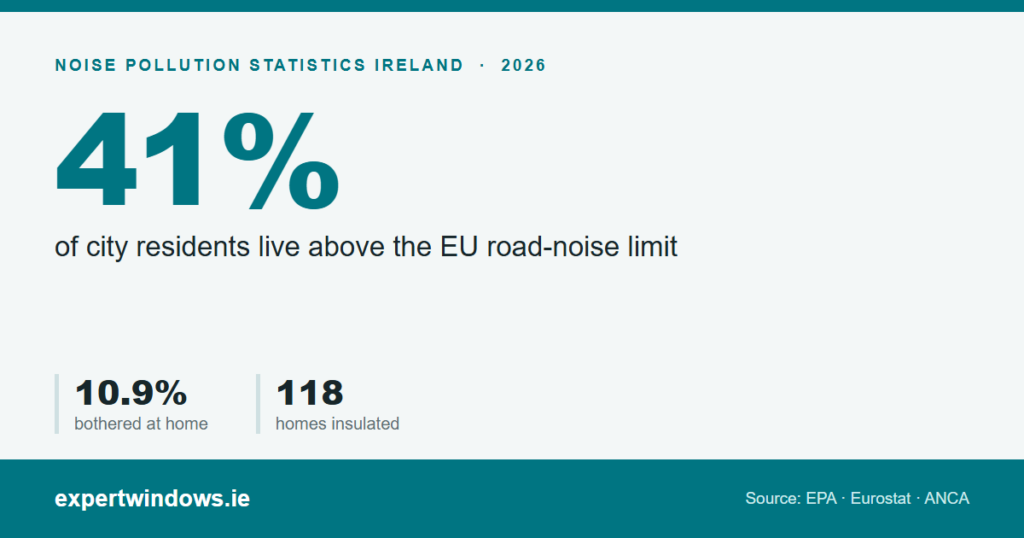
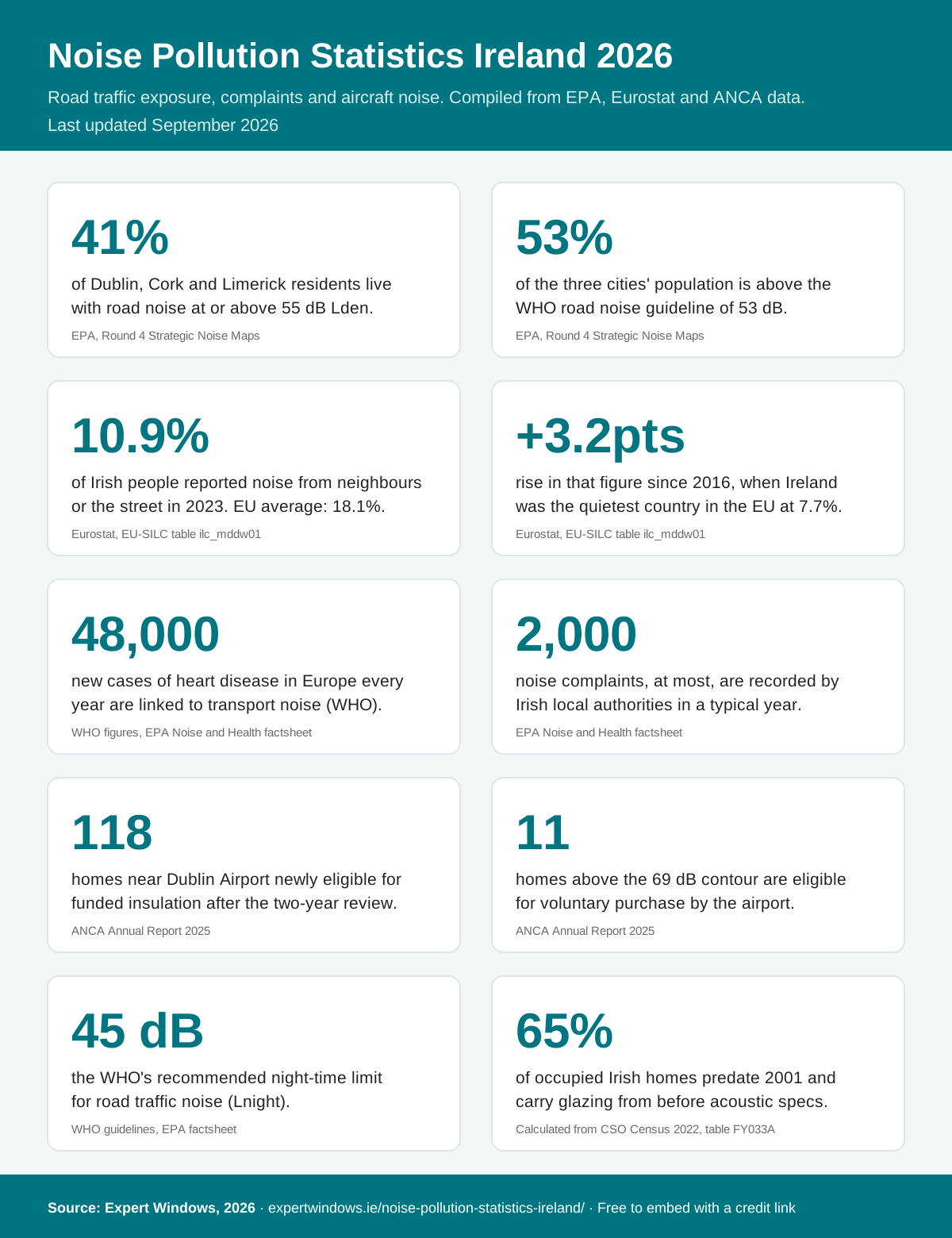
- 41% of the population of the Dublin, Cork and Limerick agglomerations is exposed to road traffic noise at or above the EU reporting threshold of 55 dB Lden. Source: EPA, Round 4 Strategic Noise Maps
- 53% of the three cities’ population is exposed to road noise above the World Health Organization guideline level of 53 dB Lden. Source: EPA, Round 4 Strategic Noise Maps
- Outside the cities, 22% of people in the mapped areas live with road noise at or above 55 dB Lden. Source: EPA, Round 4 Strategic Noise Maps
- 10.9% of people in Ireland reported noise from neighbours or the street in 2023, against an EU average of 18.1%. Source: Eurostat, table ilc_mddw01
- Ireland reported the lowest neighbour and street noise in the EU in 2016 at 7.7%, a rate that has since risen by more than three percentage points. Source: Eurostat, table ilc_mddw01
- Long-term transport noise contributes to about 48,000 new cases of heart disease and 12,000 premature deaths in Europe every year. Source: WHO figures in the EPA Noise and Health factsheet
- Irish local authorities typically record around 1,500 to 2,000 noise complaints each year. Source: EPA Noise and Health factsheet
- 118 dwellings around Dublin Airport became eligible for building insulation measures following the two-year review of the North Runway noise contours. Source: ANCA Annual Report 2025
- 11 homes in the highest aircraft noise band, above a 69 dB summer average, are eligible for voluntary purchase by the airport authority. Source: ANCA Annual Report 2025
- The WHO recommends keeping road traffic noise below 53 dB Lden by day and 45 dB Lnight at night. Source: WHO guidelines in the EPA factsheet
How Many People Are Exposed to Traffic Noise
Ireland measures environmental noise the way the rest of the EU does, through strategic noise maps prepared every five years under the Environmental Noise Directive. The current maps, Round 4, model the annual average for 2021 and cover major roads, railways, Dublin Airport and the three cities of Dublin, Cork and Limerick, each treated as an agglomeration.
The EPA’s summary of the Round 4 results puts the exposure plainly: approximately 41% of the population of the three agglomerations lives with road traffic noise at or above 55 dB Lden, the EU’s mandatory reporting threshold, and approximately 53% lives above the stricter 53 dB guideline set by the World Health Organization. Outside the cities, around 22% of people in the mapped areas are exposed at or above the 55 dB threshold. Road traffic, particularly in urban areas, is the predominant source of transport noise in Ireland.
Lden is the day, evening and night average, weighted for the extra annoyance of evening and night noise. Its night-time companion, Lnight, carries an EU reporting threshold of 50 dB, and the WHO recommends keeping road noise below 45 dB Lnight because of its link to sleep disturbance.
What Noise Does to Health
The health case against chronic noise is stronger than most people expect. According to WHO figures cited in the EPA’s Noise and Health factsheet, long-term exposure to environmental noise from road, rail, aircraft and industry contributes to about 48,000 new cases of heart disease and 12,000 premature deaths in Europe every year, alongside its effects on sleep, cardiovascular and metabolic function. That evidence is what pushed the WHO’s 2018 European guidelines to recommend the 53 dB day and 45 dB night limits for road traffic that Ireland’s mapped cities currently exceed for around half of their residents.
What the Decibel Levels Mean
The thresholds in the exposure data sit on a scale most people know by feel rather than by number. The EPA’s comparative levels put everyday sounds against the figures used in the maps:
| Sound | Approximate level, dB(A) |
|---|---|
| Car horn at close range | 110 |
| Petrol lawn mower at close range | 100 |
| Noisy urban street | 80 |
| Busy highway at 15 metres | 70 |
| Commercial area | 60 |
| Quiet urban area | 50 |
| Quiet rural area | 40 |
| Bedroom at night | 30 |
Levels adapted from the comparative scale in the EPA Noise and Health factsheet. Because decibels are logarithmic, the difference between a 55 dB street and the WHO’s 45 dB night guideline is not a fifth quieter but roughly a halving of perceived loudness twice over.
Noise Complaints and Who Makes Them
Formal complaints are the visible tip of the exposure data. Irish local authorities typically record around 1,500 to 2,000 noise complaints each year, falling into four main categories: entertainment, domestic and neighbourhood noise, industrial and commercial activity, and transport, according to the EPA.
Survey data suggests the underlying irritation is far wider than the complaint count. Eurostat’s EU-SILC housing indicator, noise from neighbours or from the street, found 10.9% of people in Ireland reporting noise at home in 2023. That is still well below the EU average of 18.1%, and Ireland recorded the lowest rate in the EU as recently as 2016 at 7.7%, but the Irish figure has drifted upward by more than three percentage points since then while the EU average has barely moved. Roughly one Irish person in nine now lives with noise they consider a problem.
Aircraft Noise and Dublin Airport
Aircraft noise is the most intensively regulated noise source in the country. Since the North Runway opened in August 2022, Dublin Airport’s noise climate has been overseen by the Aircraft Noise Competent Authority (ANCA) within Fingal County Council, and its Annual Report for 2025 sets out where mitigation now stands.
Homes inside the 63 dB summer-average contour qualify for fully funded insulation under the runway’s planning conditions, with eligibility reviewed every two years. The first post-opening review, audited by ANCA in 2025, found 118 dwellings eligible for building insulation measures, along with 5 schools and preschools inside the 60 dB contour. At the extreme end, 11 homes above the 69 dB contour are eligible for voluntary purchase by the airport authority.
The framework grew again in July 2025, when An Coimisiún Pleanála approved a night-time noise quota system for the airport, limits on night use of the North Runway, and a new Residential Sound Insulation Grant Scheme covering bedroom insulation for homes along arrival and departure routes. That decision is under judicial review, so the scheme’s rollout may shift, but the direction is clear: window and building insulation is now a formal instrument of Irish aviation policy.
The Rules That Govern Noise in Ireland
The Environmental Noise Directive, implemented in Ireland by the Environmental Noise Regulations 2018, requires strategic noise maps every five years for major roads with over 3 million vehicle passages, railways over 30,000 passages, airports over 50,000 movements and cities over 100,000 people. Where average exposure exceeds 55 dB Lden or 50 dB Lnight, the responsible authorities must prepare Noise Action Plans, and the Round 4 plans are now published. The EPA lists the mitigation measures those plans lean on: low-noise road surfaces, lower speed limits, low-emission zones and, for the most exposed homes, building-level treatment.
For individual households, complaints about neighbourhood or commercial noise run through the local authority route, with around 1,500 to 2,000 recorded nationally each year.
What the Numbers Mean for a Quiet Home
The exposure statistics describe outdoor noise, and the gap between outside and inside is largely decided by the building envelope, with windows as its weakest acoustic point. That is why every formal mitigation scheme in the country, from the Dublin Airport insulation programmes to the new bedroom-focused RSIGS, treats glazing as a core measure rather than a finish.
The age of the housing stock sets the baseline. As our Irish housing stock statistics page shows, 65% of occupied Irish homes were built before 2001, which means single glazing and early double glazing installed long before acoustic performance was part of the specification. For the half of urban Ireland living above the WHO’s road noise guideline, upgrading those windows is the one mitigation measure a household can carry out without waiting for a road resurfacing or an action plan.
Method and Sources
The figures on this page were compiled in September 2026 from the Environmental Protection Agency (Round 4 Strategic Noise Maps summary and the Noise and Health factsheet, which cites the World Health Organization’s 2018 Environmental Noise Guidelines), Eurostat (EU-SILC table ilc_mddw01, extracted via the Eurostat API on 14 September 2026), and the Aircraft Noise Competent Authority’s Annual Report 2025, published by Fingal County Council in February 2026. The Round 4 maps model the 2021 annual average, and the EU-SILC noise indicator for Ireland was last collected in 2023. Every figure was checked against its source before publication, and the page will be updated when the EPA publishes Round 5 mapping results and when Eurostat releases the next SILC housing module.
How Expert Windows Helps
Windows are the part of the building envelope that decides how much of the street reaches your living room. Expert Windows supplies and fits acoustic windows and soundproof windows across Dublin and the surrounding counties, along with triple glazed units that improve both thermal and acoustic performance. If traffic, aircraft or neighbourhood noise is reaching the rooms where you sleep and work, contact us for a survey and a quotation.