Skip to content
Last updated: September 2026. Human written and fact checked against each named source.
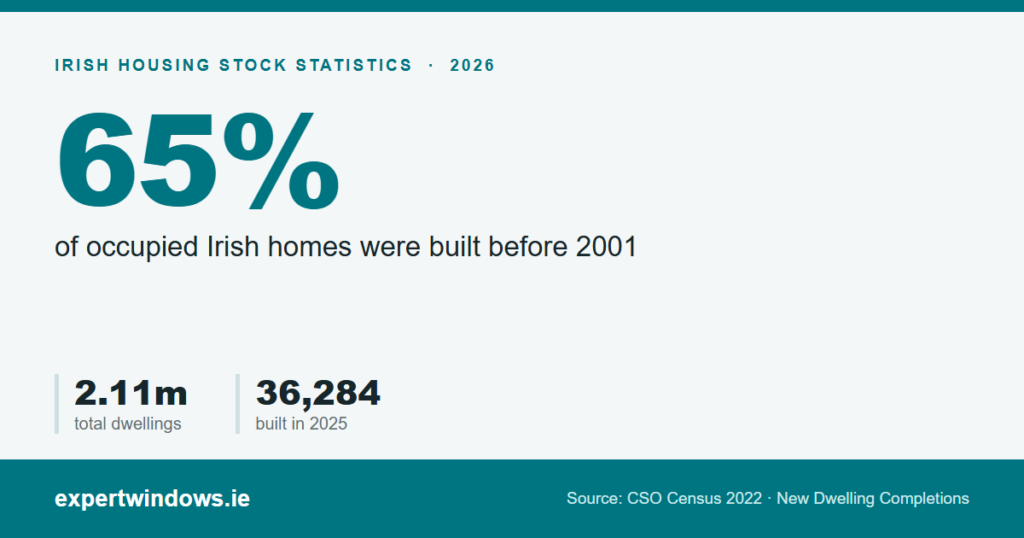
Ireland has just over 2.1 million homes, and they are old: two thirds of the occupied stock predates 2001, and one home in twelve was built before 1919. At the same time, the country has just recorded its highest year of housebuilding since modern records began, with apartments taking a share of construction they have never held before. This page gathers the current Irish housing stock statistics in one place, covering how many homes exist, how old they are, what types they are, and what is being built now, with every figure linked to its primary source.
Key Irish Housing Stock Statistics at a Glance
- Ireland’s total stock of habitable permanent housing was 2,112,121 dwellings at Census 2022, up over 5% on 2016. Source: CSO, Census 2022 Profile 2 Housing
- 1,836,728 of those dwellings were occupied, while 163,433 were vacant, an 11% fall in vacancy since 2016. Source: CSO, Census 2022
- 65% of occupied Irish homes were built before 2001, and 90% before 2011. Calculated from CSO Census 2022, table FY033A
- 154,290 occupied dwellings, one in twelve, were built before 1919. Source: CSO Census 2022, table FY033A
- 36,284 new dwellings were completed in 2025, up 20.4% on 2024 and the highest annual total since the series began in 2011. Source: CSO, New Dwelling Completions Q4 2025
- 12,047 apartments were completed in 2025, up 38.7% in a year; apartments were 33.2% of all completions, double their 16.3% share in 2019. Source: CSO, January 2026
- 57.6% of 2025 completions were in Dublin or the Mid-East, and 70.3% of Dublin’s completions were apartments. Source: CSO, January 2026
- Roughly a third of occupied homes, over 655,000, have three bedrooms. Source: CSO, Census 2022
- The average BER-rated Irish dwelling has a floor area of 118 square metres, rising to 168 for detached houses. Source: CSO, Domestic Building Energy Ratings Q1 2026
- 99% of rated homes built since 2020 hold an A rating, against 6% of those built between 2005 and 2009. Source: CSO, 2026

How Many Homes Ireland Has
Census 2022, the most recent full count, put Ireland’s habitable permanent housing stock at 2,112,121 dwellings, an increase of 5.4% on Census 2016. Of those, 1,836,728 were occupied on census night, up 8% on 2016, while the number of vacant dwellings fell by roughly 11% to 163,433.
The stock has grown since. The CSO’s New Dwelling Completions series recorded 30,147 completions in 2024 and 36,284 in 2025, so those two years alone added over 66,000 homes to the census baseline. Counting the 2022 and 2023 output as well, Ireland’s housing stock in 2026 is comfortably above the 2.1 million census figure and heading past 2.2 million, a derived estimate that does not account for demolitions or conversions.
Vacancy is falling but remains concentrated in the west and north-west: GeoDirectory counted 81,373 vacant homes in June 2026, with Leitrim’s vacancy rate at 11.5% against 1.4% in Dublin. See our vacant and derelict homes statistics.
How Old Irish Homes Are
Age defines the Irish housing stock more than any other characteristic. The CSO’s year-built table from Census 2022 breaks the 1,836,728 occupied dwellings down as follows, with shares calculated by Expert Windows:
| Period built | Occupied dwellings | Share of occupied stock |
|---|---|---|
| Before 1919 | 154,290 | 8.4% |
| 1919 to 1945 | 113,788 | 6.2% |
| 1946 to 1960 | 132,276 | 7.2% |
| 1961 to 1970 | 122,685 | 6.7% |
| 1971 to 1980 | 224,733 | 12.2% |
| 1981 to 1990 | 185,556 | 10.1% |
| 1991 to 2000 | 267,186 | 14.5% |
| 2001 to 2010 | 450,817 | 24.5% |
| 2011 to 2015 | 49,160 | 2.7% |
| 2016 or later | 93,128 | 5.1% |
| Not stated | 43,109 | 2.3% |
Summing the pre-2001 rows, 1,200,514 occupied homes, or 65% of the stock, were built before 2001, and around 90% predate 2011. The 1970s alone contributed 224,733 homes that are still occupied, more than any earlier decade, and all of them built before modern regulations on insulation and glazing. At the other end, the 154,290 homes built before 1919 include most of the country’s sash-windowed period housing.
The census also shows how sharply construction collapsed and recovered: only 49,160 occupied homes date from 2011 to 2015, the smallest cohort in the table, while the number built between 2016 and the 2022 census was nearly twice as high.
What Kinds of Homes They Are
The Census 2022 occupied dwellings analysis shows a stock dominated by houses with three or more bedrooms. About a third of occupied dwellings, over 655,000, have three bedrooms, another quarter have four, 16% have two, 8% have five or more and about 6% have one. Crowding is rare by the census measure: 58,869 dwellings had more than one person per room, while over 860,000 had fewer than 0.5 persons per room.
Apartments are a recent addition in historical terms. They made up just 3% of the occupied stock built in the 1970s, peaked at over 20% of homes built between 2001 and 2010, and accounted for 15% of dwellings built between 2016 and the census. As the next section shows, that share has since jumped again.
What Ireland Is Building Now
The CSO’s New Dwelling Completions release for Q4 2025, published on 29 January 2026, recorded 36,284 completions in 2025, up 20.4% from 30,147 in 2024 and the highest annual figure since the electricity-connections series began in 2011. The fourth quarter alone delivered 11,994 homes, 38.5% more than a year earlier.
The composition is shifting decisively toward apartments. There were 12,047 apartment completions in 2025, up 38.7% from 8,687 in 2024. Apartments took 33.2% of all completions, double their 16.3% share in 2019, while scheme houses took 50.5% and one-off single dwellings 16.3%. Estate houses still lead, but the gap is closing every year.
Building remains heavily concentrated on the east coast. Dublin accounted for 37.7% of national completions and the Mid-East (Kildare, Louth, Meath and Wicklow) for a further 19.9%, so 57.6% of all new homes were completed in that corridor. Within Dublin, 70.3% of completions were apartments, and Dublin took 79.8% of all apartments completed nationally. The busiest Local Electoral Areas in the country were Clondalkin (1,399 completions), North Inner City (1,363) and Blanchardstown-Mulhuddart (1,094), all in Dublin.
Even that record year fell short of policy ambitions. As RTÉ reported, the Government’s target for 2025 was 41,000 homes, and it has since moved to a cumulative goal of 300,000 homes between 2025 and the end of 2030, a pace that would require annual output well above the 2025 figure.
Size and Energy Performance by Age
The BER register adds size and performance detail to the census picture. According to the CSO’s Domestic Building Energy Ratings release for Q1 2026, the average rated dwelling has a floor area of 118 square metres. Detached houses average 168 square metres, while basement apartments are the smallest category at 63 square metres.
Energy performance tracks age almost perfectly. A ratings were awarded to 99% of rated homes built since 2020 and 94% of those built between 2015 and 2019, but to only 38% of homes built between 2010 and 2014 and 6% of those built between 2005 and 2009. Older cohorts score progressively worse, which is why two thirds of rated homes still sit below the B2 standard that Government retrofit policy targets. The full breakdown, including ratings by county and heating fuel, is on our home energy efficiency statistics for Ireland page.
What the Age Profile Means for Renovation
The numbers explain why Ireland’s renovation market is largely a replacement market. With 1.2 million occupied homes built before 2001, the typical Irish house carries windows and doors that predate current standards, and the 450,817 Celtic Tiger era homes of 2001 to 2010 are now 16 to 25 years old, the age at which first-generation uPVC double glazing commonly reaches the end of its life. The 154,290 pre-1919 homes bring their own requirements, where replacements need to respect original sash proportions and glazing bars.
New-build patterns cut the other way. With a third of new homes now apartments, and 99% of new stock A-rated from day one, the demand for window replacement concentrates almost entirely in the existing stock rather than in anything built in the last decade. The 2026 SEAI windows and doors grant recognises exactly that: its eligibility begins with homes built before 2011, a cut-off that covers roughly 90% of the occupied stock. Uptake figures for the grant are on our SEAI windows and doors grant statistics page.
Older homes also matter for fire safety, because many bedroom windows were fitted before the current escape window guidance. Fire brigades attended 4,131 fires in Irish homes in 2025, as our Irish house fire statistics show.
Method and Sources
The figures on this page were compiled in September 2026 from the Central Statistics Office: Census of Population 2022 Profile 2 Housing in Ireland (housing stock and occupied dwellings chapters, and table FY033A via the CSO data API), New Dwelling Completions Q4 2025 (published 29 January 2026), and Domestic Building Energy Ratings Q1 2026, along with RTÉ’s report of 29 January 2026 on housing targets. Shares of the occupied stock by period built, the pre-2001 and pre-2011 totals, and the post-census stock estimate were calculated by Expert Windows from the cited tables and are labelled as such. Every figure was checked against its source before publication, and the page will be updated when the CSO publishes its next completions release and when Census 2027 results begin to appear.
How Expert Windows Helps
Most of the homes in these statistics were built before modern glazing standards, and that is the stock we work in every day. Expert Windows supplies and fits replacement uPVC, timber and aluminium windows across Dublin and the surrounding counties, including sash windows for period properties and apartment window replacement for multi-unit buildings. If your home belongs to one of the older cohorts in the table above, our window replacement team can survey it and provide a quotation.