Skip to content
Last updated: August 2026. Human written and fact checked against each named source.
On 2 March 2026, SEAI opened the first stand-alone grant for replacing windows and external doors in Irish homes, ending a period in which glazing upgrades were only funded inside full retrofits. The response was immediate, and the scheme is already reshaping how homeowners approach energy upgrades. This page gathers the SEAI windows and doors grant statistics in one place: what the grant pays, who qualifies, how many have applied, and where it sits in Ireland’s wider retrofit programme, with every figure linked to its source.
Key SEAI Windows and Doors Grant Statistics at a Glance
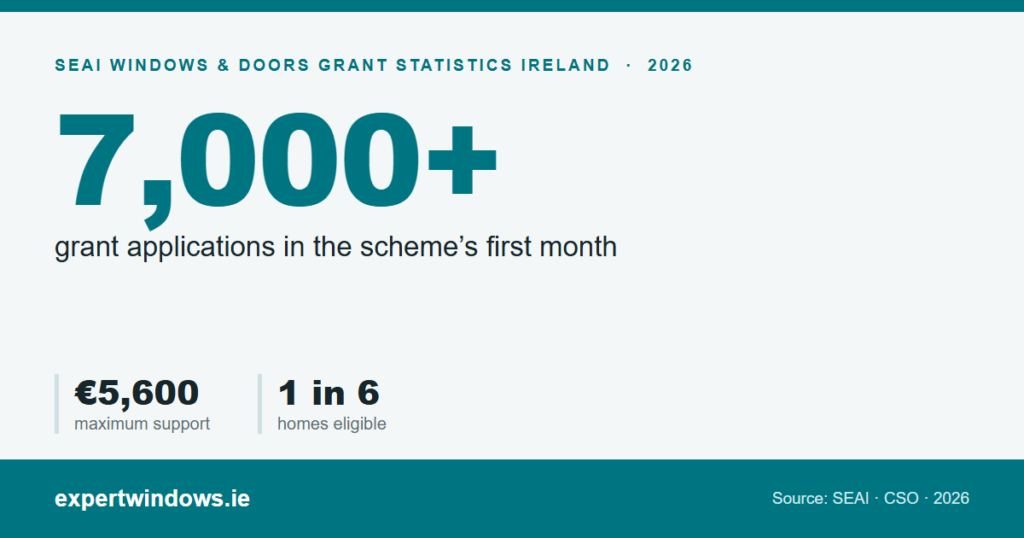
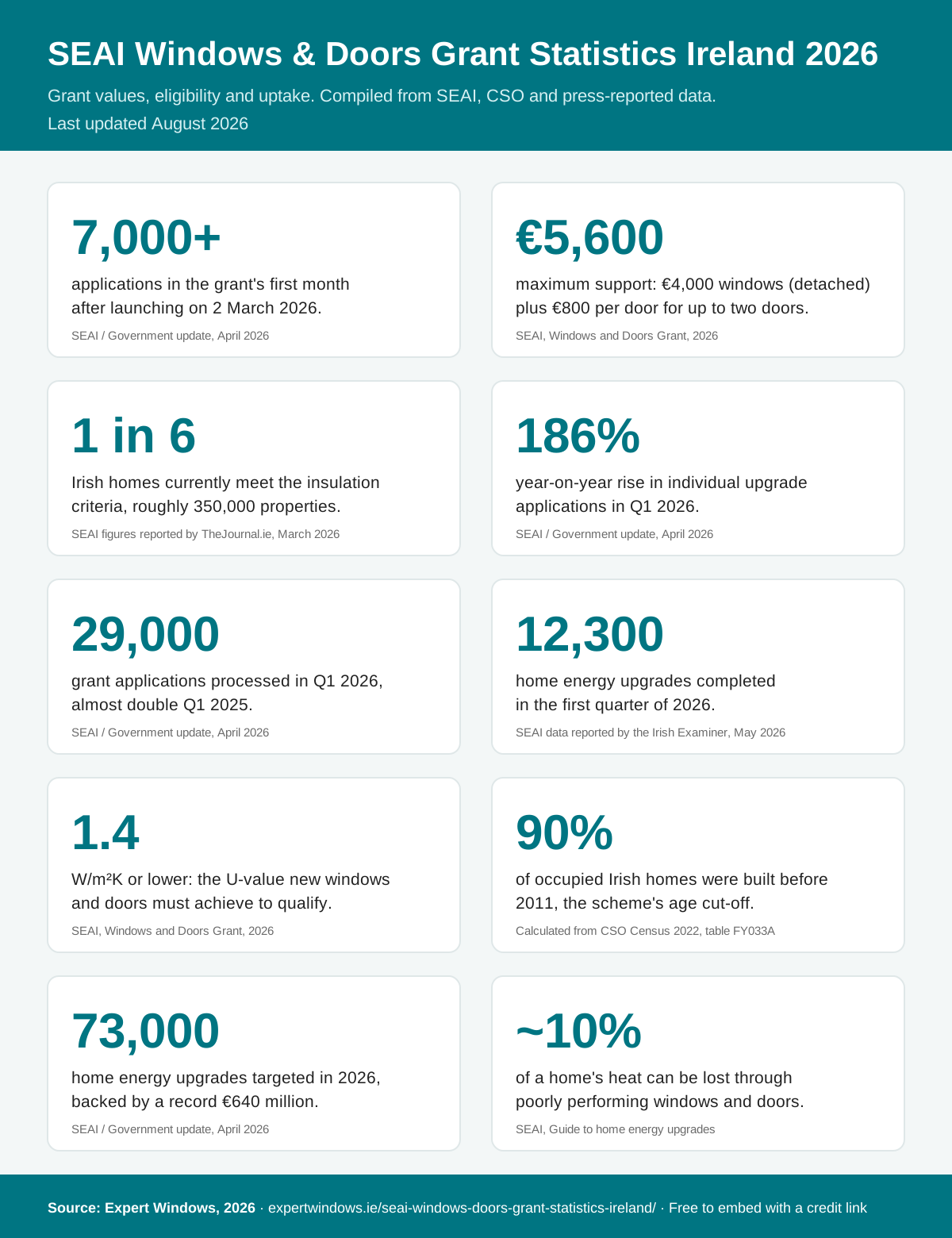
- More than 7,000 homeowners applied for the windows and doors grant in its first month. Source: SEAI, April 2026
- The maximum combined support is €5,600: up to €4,000 for windows on a detached house plus €800 per external door for up to two doors. Source: SEAI Windows and Doors Grant
- Only around one in six Irish homes, up to 350,000 of the 2.1 million counted in Census 2022, currently meet the insulation criteria. Source: SEAI figures reported by TheJournal.ie, March 2026
- Applications for individual home energy upgrades rose 186% year on year in the first quarter of 2026. Source: SEAI, April 2026
- SEAI processed 29,000 grant applications in the first quarter of 2026, almost double the same period in 2025. Source: SEAI, April 2026
- 12,300 home energy upgrades were supported through Government-funded schemes in the first quarter of 2026. Source: SEAI figures reported by the Irish Examiner, May 2026
- Budget 2026 allocated a record €640 million to home energy upgrades, targeting 73,000 upgrades this year. Source: SEAI, April 2026
- New windows and doors must achieve a U-value of 1.4 W/m²K or lower to qualify. Source: SEAI Windows and Doors Grant
- The home must have been built and occupied before 2011, a condition that covers roughly 90% of Ireland’s occupied housing stock. Sources: SEAI; calculated from CSO Census 2022, table FY033A
- A home can lose about 10% of its heat through poorly performing windows and doors. Source: SEAI guide to home energy upgrades
What the Grant Pays
The grant values are fixed per property type rather than per window, so a homeowner can replace some or all of their glazing within one application. According to the SEAI scheme page, the amounts are:
| Measure | Grant value |
|---|---|
| Windows, apartment | €1,500 |
| Windows, mid-terrace house | €1,800 |
| Windows, semi-detached or end-of-terrace house | €3,000 |
| Windows, detached house | €4,000 |
| External doors | €800 per door, maximum two doors |
A detached house replacing its windows and two external doors can therefore claim up to €5,600. Applicants can apply for windows only, doors only, or both, and SEAI confirmed in a February 2026 briefing that roof windows and skylights are also covered. Eligible applicants include homeowners, landlords, holiday home owners, companies, owner management companies, approved housing bodies and registered charities.
Who Qualifies, in Numbers
Three conditions define eligibility. The home must have been built and occupied before 2011. The new windows and doors must achieve a U-value of 1.4 W/m²K or lower, confirmed on the declaration of works. And the building fabric must already perform well: attic and wall insulation graded Good or Very Good on a BER advisory report, or a Heat Loss Indicator of 2.3 W/K·m² or lower on the post-works BER.
The age condition is broad. Calculated from the CSO’s Census 2022 year-built data, around 90% of Ireland’s 1.84 million occupied dwellings were built before 2011, and 65% before 2001.
The insulation condition is the narrow one. Analysis reported by TheJournal.ie in March 2026, based on SEAI figures, estimated that up to 350,000 homes, roughly one in six of the national stock, currently meet the insulation criteria. The remainder need attic or wall insulation first, for which SEAI grants are also available, and homes brought up to standard become eligible afterwards. SEAI’s stated reasoning is that in an under-insulated home most heat escapes through the roof and walls before it reaches the windows, so new glazing alone delivers a much smaller saving.
How Homeowners Prove the Insulation Standard
SEAI’s guidance sets out three routes to demonstrating that a home’s attic and wall insulation meets the standard. If the home previously received SEAI grants for attic and wall insulation, the requirement is automatically met. If the home has a BER with an advisory report, insulation graded Good or Very Good qualifies; certificates and advisory reports can be retrieved from the national register using the home’s MPRN. Where neither applies, a BER assessor can review older reports or carry out a pre-works assessment, and homeowners can choose a combined pre- and post-works BER service.
The scheme also carries payment conditions beyond the U-value. The property must be ventilated for healthy indoor air, with a permanent vent in any room containing an open-flued appliance. Windows with an exterior drop greater than 1.4 metres must have restrictors fitted, and escape windows must keep suitably sized openings and compliant locking mechanisms. These are checked through the declaration of works and the post-works BER rather than through an upfront inspection.
Uptake Since Launch
Applications opened on Monday 2 March 2026, with works ordered or started on or after 27 January 2026 also eligible where the scheme conditions are met. Demand was immediate. In a Government update of 21 April 2026, SEAI reported more than 7,000 applications for window and door upgrades, even though the grant had only been open for the final month of the quarter.
The new grant lifted the whole programme. SEAI processed 29,000 grant applications between January and March 2026, almost double the same period in 2025. Applications for individual upgrades were up 186% year on year, with attic insulation applications up 81%, cavity wall insulation up 62% and heat pump applications up 95%. By early May, SEAI figures reported by the Irish Examiner put total 2026 applications at 25,000 processed, alongside 12,300 completed home energy upgrades in the first quarter.
The Grant in Ireland’s Wider Retrofit Programme
The windows and doors grant is one measure in the National Residential Retrofit Plan announced on 27 January 2026, which also raised heat pump support to a maximum of €12,500, increased attic and cavity wall insulation grants, and introduced supports for first-time buyers and homeowners on qualifying welfare payments. Between 2019 and April 2026, SEAI reported that 257,000 home energy upgrades had been delivered with over €1.7 billion in Government funding.
2025 set the baseline the new scheme is building on: over 58,000 home energy upgrades were completed, 8% more than in 2024 and a record year, supported by €645 million in Government funding, according to SEAI’s end-of-year statement. For 2026, Budget funding rose to €640 million for home upgrades specifically, with a target of 73,000 upgrades, which would be a 26% increase on the 2025 total.
The Warmer Homes Scheme runs alongside the paid grants: over 8,000 homes at risk of energy poverty received fully funded upgrades in 2025. Under that scheme, SEAI’s surveyor decides the measures, and windows are replaced only in limited circumstances.
The Housing Stock Behind the Demand
The scale of interest reflects the state of Ireland’s glazing. Of the 1.35 million homes with a Building Energy Rating, 34% are rated D or lower according to the CSO’s Q1 2026 BER release, and single-glazed and early double-glazed windows are concentrated in the pre-2001 stock that makes up 65% of occupied homes. SEAI’s guidance puts heat loss through poorly performing windows and doors at about 10% of a home’s total, with window frames accounting for 20% to 30% of the whole window area. Our full home energy efficiency statistics for Ireland page covers the BER picture county by county.
One administrative change matters for applicants from mid-2026: Ireland’s BER scale was simplified from 24 May 2026, moving from fifteen bands to eight (A0 to G), as reported by the Irish Examiner. Post-works BER certificates issued after that date use the new scale, while older certificates keep the legacy bands until they are renewed.
What the Grant Covers Against Typical Costs
The grant is a fixed contribution, not a percentage, so how far it stretches depends on the project. Expert Windows’ own 2026 window replacement price guide puts a complete replacement for a standard three-bedroom semi-detached home at roughly €4,500 to €10,000 or more depending on materials and specification. Against that range, the €3,000 semi-detached grant covers somewhere between a third and two thirds of a typical project, and the €4,000 detached grant a similar share of a larger one. Because only units rated 1.4 W/m²K or better qualify, the grant effectively subsidises the higher-performance end of the market: modern A-rated double glazing and triple glazing both clear the threshold.
The upgrade also feeds into what a home is worth. ESRI research based on over 1.2 million Irish property listings found a 9.3% sale price premium for an A-rated home over a comparable D-rated one, and glazing is one of the fabric measures that moves a rating. The window-by-window economics are covered in our home energy efficiency statistics page.
Windows, Heat Pump Readiness and the Bigger Grants
SEAI frames the windows and doors grant as a step toward heat pump readiness, and the numbers explain why. Heat pumps are present in just 15% of Ireland’s BER-rated dwellings overall, but in 84% of those built between 2020 and 2024, according to the CSO. Bringing an older home’s fabric up to standard, insulation first, then glazing, is what closes that gap, and the same National Residential Retrofit Plan raised the maximum heat pump system grant to €12,500 from 3 February 2026. A household that uses the windows and doors grant this year is, in SEAI’s design, part-way through the fabric work a heat pump needs.
Process and Timelines
Homeowners can apply directly to SEAI online using a registered contractor, or through a One Stop Shop where the grant is deducted from the project cost upfront. The self-apply route runs in seven steps set out on the scheme page: get quotes from registered contractors, apply to SEAI for a grant offer, wait for the offer before starting, complete the works, get a post-works BER, submit the documents, and receive payment, with inspections applying in some cases.
Works must not begin before grant approval, except for the transition window covering orders placed on or after 27 January 2026. A post-works BER is required and is itself grant-aided. SEAI quotes standard lead times of six to ten weeks from order to installation for windows and four to six weeks for doors, which means an application made in late summer can still be installed before the heating season.
Method and Sources
The figures on this page were compiled in August 2026 from the Sustainable Energy Authority of Ireland (the windows and doors grant scheme page, the briefing of 20 February 2026, the end-of-year statement of 8 January 2026 and the Government update of 21 April 2026), the Central Statistics Office (Domestic Building Energy Ratings Q1 2026 and Census 2022 table FY033A), and SEAI data as reported by TheJournal.ie (28 March 2026) and the Irish Examiner (4 May 2026). The share of homes built before 2011 was calculated by Expert Windows from the cited Census table. Every figure was checked against its source before publication, and the page will be updated when SEAI publishes its next quarterly application figures.
How Expert Windows Helps
Expert Windows supplies and fits double glazed and triple-pane windows and energy-efficient external doors across Dublin and the surrounding counties, and can advise on the U-values, certification and post-works BER the grant requires. Our guide to window and door grants in Ireland walks through the application step by step, and if you want to know whether your home is likely to qualify, contact us for a survey and a quotation.