Skip to content


Last updated: October 2026. Human written and fact checked against each named source.
Ireland has somewhere between 70,000 and 163,000 vacant homes, depending on which official measure you use, and 19,137 properties were recorded as derelict in mid-2026. This page gathers the current statistics on vacant and derelict homes in Ireland in one place: how many there are, how the main measures differ, where vacancy is highest, why homes sit empty, what condition they are in, and how many are being brought back into use with grant support, with every figure linked to its primary source.
Key Vacant and Derelict Homes Statistics for Ireland at a Glance
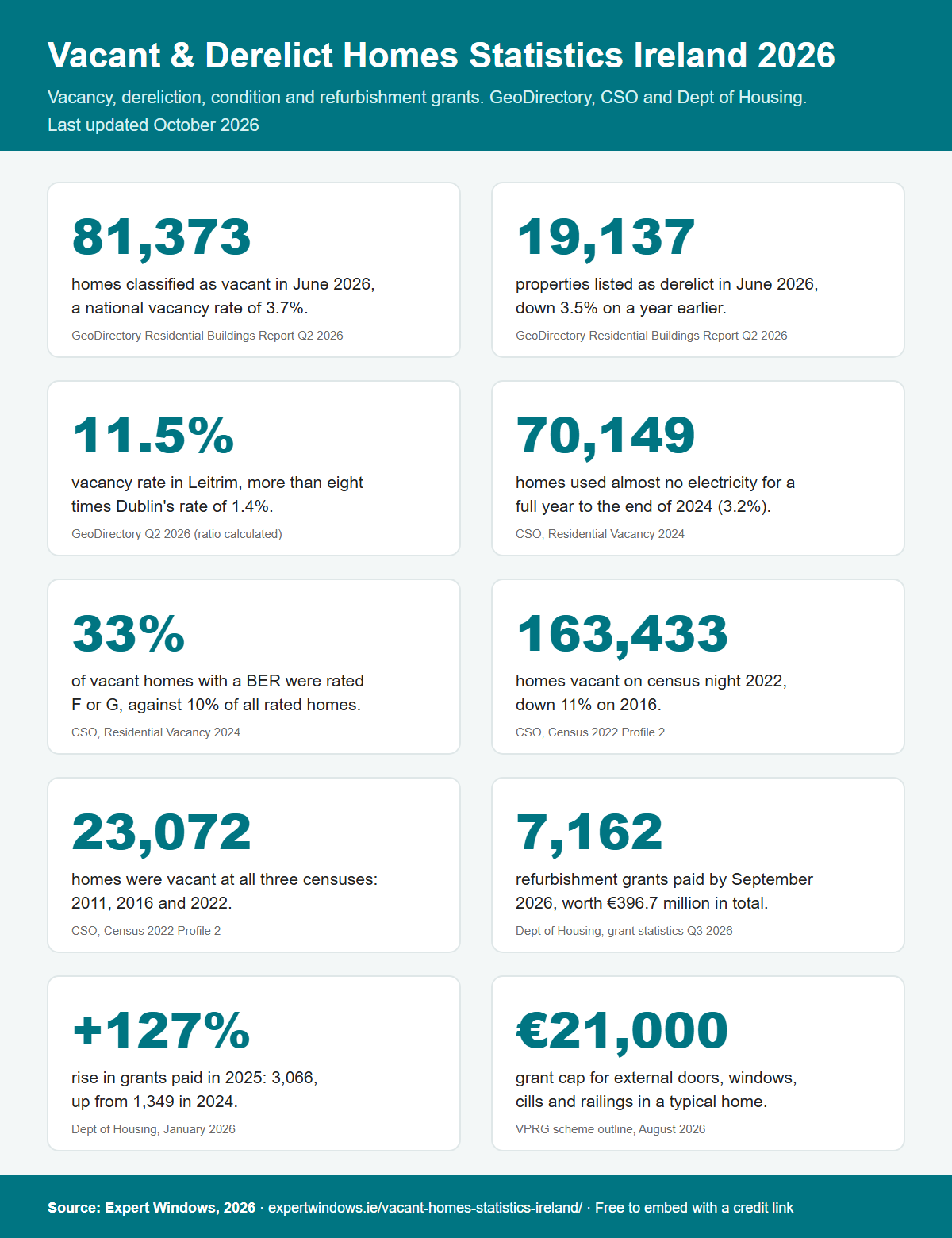
- 81,373 homes were classified as vacant in June 2026, a national vacancy rate of 3.7%. Source: GeoDirectory Residential Buildings Report Q2 2026
- 19,137 properties were listed as derelict in June 2026, down 3.5% on a year earlier. Source: GeoDirectory Q2 2026
- Leitrim had the highest vacancy rate at 11.5%, more than eight times Dublin’s 1.4%. Source: GeoDirectory Q2 2026 (ratio calculated)
- 70,149 homes used almost no electricity for a full year to the end of 2024, a vacancy rate of 3.2%. Source: CSO, Residential Vacancy Based on Metered Electricity Consumption 2024
- A third (33%) of vacant homes with a BER were rated F or G, against 10% of all rated homes. Source: CSO, 2024
- Census 2022 counted 163,433 vacant homes on census night, down 11% on 2016, plus 66,956 unoccupied holiday homes. Source: CSO, Census 2022 Profile 2
- 23,072 homes were vacant at all three censuses, in 2011, 2016 and 2022. Source: CSO, Census 2022 Profile 2
- The Vacant Property Refurbishment Grant had paid out 7,162 grants worth €396.7 million by 30 September 2026. Source: Department of Housing, Q3 2026
- 3,066 grants were paid in 2025, up 127% on the 1,349 paid in 2024. Source: Department of Housing, January 2026
- Under the grant, work on external doors, windows, cills and railings is capped at €21,000 for a typical home. Source: Vacant Property Refurbishment Grant scheme outline, August 2026
How Many Homes Are Vacant in Ireland
There is no single official count of vacant homes in Ireland. Three regular measures exist, and each uses a different definition, so their totals are not directly comparable. The CSO stresses this point in its own electricity-based vacancy release, which it publishes as an experimental Frontier Series output.
| Measure | What it counts | Vacant homes | Vacancy rate |
|---|---|---|---|
| Census 2022 (CSO) | Homes found empty by enumerators on census night, 3 April 2022, excluding holiday homes | 163,433 | Just under 8% |
| Metered electricity (CSO) | Homes using about 2 kWh of electricity a day or less for at least four quarters in a row, Q4 2024 | 70,149 | 3.2% |
| GeoDirectory | Residential units classified as vacant in the An Post GeoDirectory database, June 2026 | 81,373 | 3.7% |
Sources: CSO Census 2022 Profile 2; CSO Residential Vacancy Based on Metered Electricity Consumption 2024; GeoDirectory Residential Buildings Report Q2 2026.
The census figure is the highest because it is a snapshot of a single night. It catches homes between tenants, homes for sale and homes being renovated on Sunday 3 April 2022, and the CSO’s Census 2022 vacant dwellings FAQ says the figure should not be used as a measure of long-term vacancy. The electricity measure is the strictest, because a home only counts once it has used almost no power for a full year. For context, the CSO says 2 kWh a day is about enough to run a medium-sized fridge.
How Vacancy Has Changed
Vacancy has fallen steadily since the property crash. Census counts of vacant homes, excluding holiday homes, went from 216,533 in 2006 to 230,056 in 2011, then down to 183,312 in 2016 and 163,433 in 2022, according to the CSO. The vacancy rate fell from 12% in 2011 to over 9% in 2016 and just under 8% in 2022. Unoccupied holiday homes moved the other way, rising 8% between 2016 and 2022 to 66,956.
The electricity measure shows the same direction. Vacant homes on that basis fell from 72,254 (3.3%) at the end of 2023 to 70,149 (3.2%) at the end of 2024. During 2024, 29,268 homes moved out of vacancy and 27,163 became vacant, so 2,105 more homes came back into use than fell empty, according to the CSO’s vacancy flows analysis.
That churn is large next to the net change. Tens of thousands of homes enter and leave vacancy each year, which is why a one-night count and a twelve-month count give such different totals.
Where Vacancy Is Highest
Every measure points to the same geography: vacancy is highest in the west and north-west and lowest in Dublin and its commuter counties.
| Highest vacancy, June 2026 | Rate | Lowest vacancy, June 2026 | Rate |
|---|---|---|---|
| Leitrim | 11.5% | Dublin | 1.4% |
| Mayo | 10.3% | Kildare | 1.6% |
| Roscommon | 9.9% | Waterford | 2.2% |
| Donegal | 8.9% | Meath | 2.4% |
| Sligo | 8.3% | Wicklow | 2.4% |
Source: GeoDirectory Residential Buildings Report Q2 2026, prepared by EY.
The CSO’s electricity data agrees. At the end of 2024 the rural vacancy rate was 5.4% against 2.2% in urban areas, and rural areas held slightly more than half of all vacant homes (35,493 of 70,149). Leitrim (7.8%), Donegal (6.3%) and Mayo (6.0%) had the highest local authority rates, and South Dublin (0.9%), Fingal (1.1%) and Kildare (1.4%) the lowest. Glenties in Donegal had the most vacant homes of any local electoral area, at 1,615.
The largest numbers of vacant homes, as opposed to the highest rates, were in Cork County (6,632), Dublin City (5,670) and Donegal (5,603), according to the same CSO release.
Why Homes Sit Empty
Census 2022 was the first census in which enumerators recorded a likely reason for each vacant home. Only one reason could be recorded, even where more than one applied.
| Reason for vacancy, Census 2022 | Vacant homes |
|---|---|
| Rental property | 33,653 |
| Former resident deceased | Over 27,000 |
| Under renovation | 23,205 |
| For sale | 17,472 |
| Resident in a nursing home or hospital | Nearly 11,000 |
| Resident with relatives | 5,018 |
Source: CSO, Census 2022 Profile 2, Vacant Dwellings. Other reasons are not shown.
Renovation alone accounted for 23,205 homes, or 14% of all vacant dwellings. The reasons vary by place. Vacancy after the owner’s death was most common in Roscommon (25%), Mayo (25%) and Galway County (24%), while renovation was the most frequent reason in Dublin City (18%), Wicklow (17%) and Dún Laoghaire-Rathdown (17%).
Long-term vacancy is a smaller, harder core. Just under 48,000 homes were vacant at both the 2016 and 2022 censuses, 2% of the housing stock, and 23,072 were vacant in 2011, 2016 and 2022, 1% of the stock. Leitrim, Mayo and Roscommon had the highest shares of homes vacant at both of the last two censuses, at 6% each.
Derelict Properties
GeoDirectory recorded 19,137 derelict properties in June 2026, a fall of 3.5% on June 2025, according to its Q2 2026 report. Mayo had the highest concentration, with 14.2% of the national total.
Dereliction also shows up in grant demand. Of the 19,986 applications made to the Vacant Property Refurbishment Grant by 30 September 2026, 9,523 were for the Derelict Property Top-up Grant, which is paid where a property is structurally unsound or on a local authority’s Derelict Sites Register. That is 47.6% of all applications, calculated from the Department of Housing’s Q3 2026 grant statistics.
The Condition of Vacant Homes
Vacant homes are older and less energy efficient than the housing stock as a whole. The CSO matched about a third (34%) of electricity-based vacant homes to a Building Energy Rating assessment. Among those, 33% were rated F or G, more than three times the 10% of all BER-assessed homes, and fewer than a fifth (18%) were built in 2001 or later, according to its 2024 release. Detached houses made up 37% of BER-matched vacant homes, and heating oil was the main heating fuel in 41%.
Homes that fell vacant during 2024 were older still. Of those with a BER, 62% were rated D, E, F or G, and 47% were built before 1970, compared with 23% of all BER-rated dwellings. Homes that came back into use were more likely to be newer and better rated, with 22% rated A or B.
That profile matters for anyone refurbishing a vacant home. Windows, doors and insulation in an F or G rated house are usually original or decades old. The national picture on BER ratings is on our home energy efficiency statistics page, and the age of Irish homes is covered in our Irish housing stock statistics.
Bringing Vacant Homes Back Into Use
The main support for owners is the Vacant Property Refurbishment Grant, run by local authorities. It pays up to €50,000 to refurbish a vacant home, with a top-up of up to €20,000 for a derelict property, bringing the total to €70,000, according to the Department of Housing. The property must have been vacant for at least two years and built before 2008.
The scheme outline sets maximum amounts for each type of work, based on a two-storey, three-bedroom semi-detached house. External completions, including doors, windows, cills and railings, are capped at €21,000 including VAT, within an overall cap of €42,700 for external completions and finishes.
Take-up has grown quickly. By 30 September 2026 the scheme had received 19,986 applications, approved 15,380 and paid 7,162 grants worth €396.7 million, according to the Department’s Q3 2026 statistics. That works out at an average of about €55,400 per completed grant, calculated from the same table. Payments rose from 1,349 in 2024 to 3,066 in 2025, and 2,548 grants were paid in the first nine months of 2026, calculated from the Department’s quarterly statistics for Q1 (816), Q2 (923) and Q3 (809). Donegal County Council had the most applications of any local authority by the end of 2025, at 1,430.
The state also taxes long-term vacancy. Vacant Homes Tax applies to homes used as a dwelling for less than 30 days in a year. Owners declared 6,775 homes vacant in the first chargeable period to October 2023, of which 3,960 were liable for the tax, and 3,457 in the second period to October 2024, of which 2,357 were liable, according to Revenue’s property tax statistics, published August 2026. The rate rose from three times a property’s standard Local Property Tax rate to five times between the two periods.
Using and Citing These Figures
Three points help when quoting these statistics. First, name the measure: the census, the CSO electricity measure and GeoDirectory count vacancy differently, so their totals should not be compared or combined. Second, the census count is a single night in April 2022 and includes homes that were only briefly empty. Third, the CSO electricity series is an experimental Frontier Series output, and the grant figures are subject to change as applications are processed.
Journalists, researchers and housing groups are welcome to use the figures and the infographic on this page. Please credit Expert Windows with a link to this page, and cite the original source named beside each figure.
Method and Sources
The figures on this page were compiled in October 2026 from the CSO’s Census of Population 2022 Profile 2 (Vacant Dwellings chapter, 27 July 2023) and its Census 2022 vacant dwellings FAQ; the CSO’s Residential Vacancy Based on Metered Electricity Consumption 2024 (24 March 2026); GeoDirectory’s Residential Buildings Report for Q2 2026 (22 July 2026); the Department of Housing, Local Government and Heritage’s Vacant Property Refurbishment Grant statistics for each quarter of 2026, its press release of 26 January 2026, its grant service page and the scheme outline of August 2026; and Revenue’s Property Tax Statistics (published August 2026). The Leitrim to Dublin ratio, the share of derelict top-up applications, the average grant, the 2026 year-to-date payments and the BER multiple were calculated by Expert Windows from the cited figures and are labelled as such. Every figure was checked against its source before publication, and the page will be updated when GeoDirectory publishes its Q3 2026 report and the CSO publishes its next vacancy release.
How Expert Windows Helps
Vacant and derelict homes often need new windows and doors before anyone can live in them. Expert Windows supplies and fits replacement windows, including uPVC windows, and entrance doors across Dublin and the surrounding counties. If you are refurbishing a vacant property, we can survey the existing windows and doors and provide a quotation to support your plans.