Skip to content

Last updated: October 2026. Human written and fact checked against each named source.
One person in five in Ireland lives in a home with damp walls, a leaking roof, or rot in the window frames or floors, one of the highest rates in the European Union. This page gathers the current statistics on damp, mould and housing quality in Ireland in one place: how common the problem is, how Ireland compares with the rest of Europe, who is most affected, what inspections of rented homes are finding, and what the rules and health evidence say, with every figure linked to its primary source.
Key Damp and Mould Statistics for Ireland at a Glance
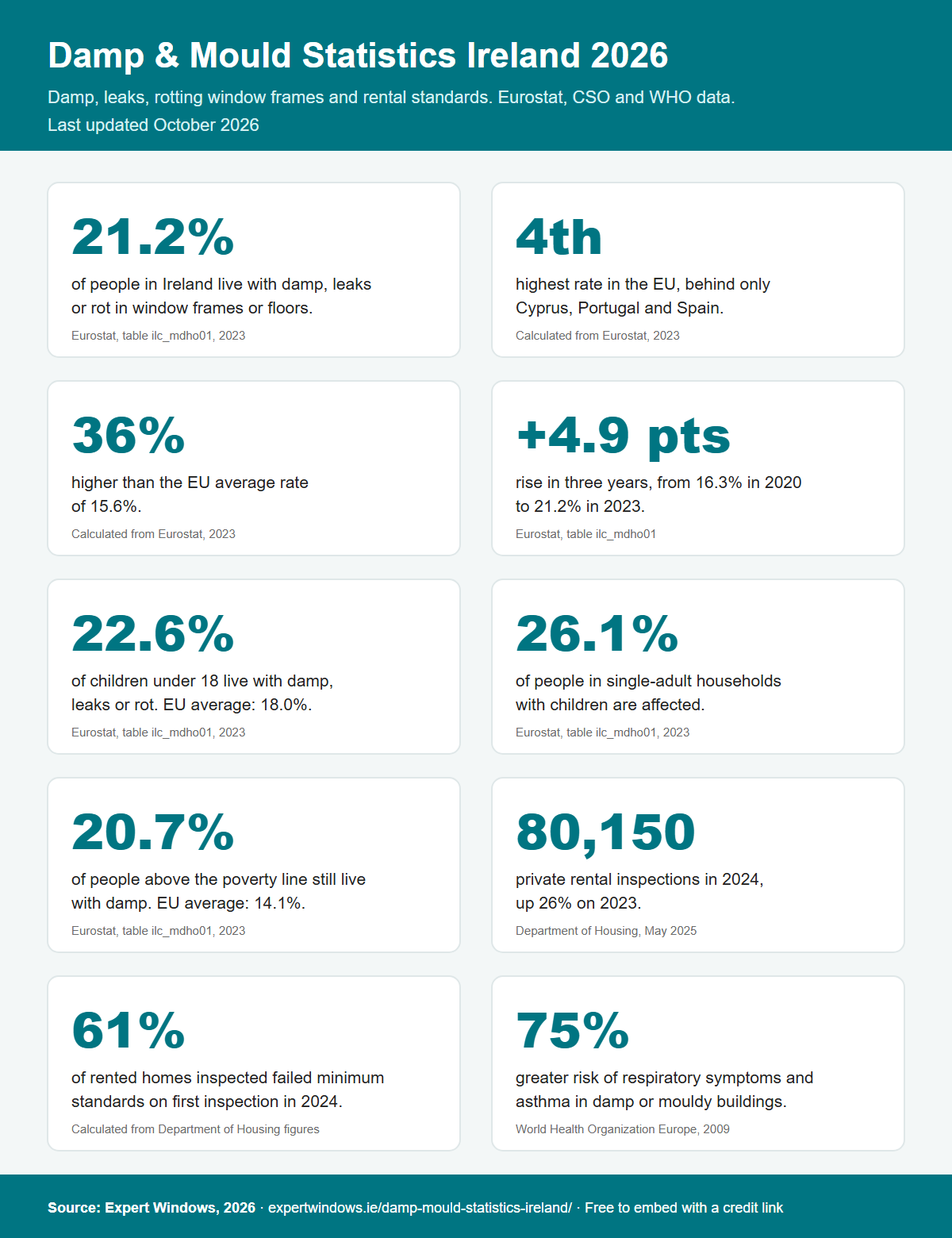
- 21.2% of people in Ireland lived in a home with a leaking roof, damp walls, floors or foundation, or rot in window frames or floors in 2023. Source: Eurostat, table ilc_mdho01
- That is the fourth highest rate in the EU, behind only Cyprus, Portugal and Spain, and well above the EU average of 15.6%. Ranking calculated from Eurostat
- The share of people affected rose from 16.3% in 2020 to 21.2% in 2023. Source: Eurostat
- 22.6% of children under 18 in Ireland live with damp, leaks or rot, against 18.0% across the EU. Source: Eurostat, 2023
- 26.1% of people in single-adult households with dependent children are affected, the highest of any household type. Source: Eurostat, 2023
- Damp is not only a low-income problem in Ireland: 20.7% of people above the poverty threshold live with it, against 14.1% across the EU. Source: Eurostat, 2023
- Local authorities carried out 80,150 inspections of private rented homes in 2024, up 26% on 2023 and four times the 2005 to 2017 annual average. Source: Department of Housing, May 2025
- Of 62,085 rented homes inspected in 2024, 37,800, about 61%, did not meet minimum standards on first inspection. Source: Department of Housing figures reported by TheJournal.ie
- Under the 2019 rental standards, windows in rented homes must be kept in good repair and not defective due to dampness. Source: Housing (Standards for Rented Houses) Regulations 2019
- People living in damp or mouldy buildings have up to a 75% greater risk of respiratory symptoms and asthma, according to the World Health Organization. Source: WHO Europe
How Many Irish Homes Have Damp
The standard European measure of damp housing comes from the EU Survey on Income and Living Conditions, which the CSO runs in Ireland. It asks whether a household’s dwelling has a leaking roof, damp walls, floors or foundation, or rot in its window frames or floors. Eurostat’s table ilc_mdho01 reports the share of the population living in such a dwelling.
The survey records damp, leaks and rot rather than mould itself, so there is no separate official count of homes with mould in Ireland. In practice the two go together: mould grows where damp persists, which is why the World Health Organization treats them as one problem in its guidance, covered below.
In 2023, the latest year published, the figure for Ireland was 21.2%, roughly one person in five. The trend has moved sharply upward:
| Year | Ireland | EU average |
|---|---|---|
| 2012 | 13.0% | 14.8% |
| 2016 | 13.3% | 15.2% |
| 2019 | 12.4% | 12.7% |
| 2020 | 16.3% | 14.8% |
| 2023 | 21.2% | 15.6% |
Share of the population living in a dwelling with a leaking roof, damp walls, floors or foundation, or rot in window frames or floor, from Eurostat. Eurostat flags a break in Ireland’s series in 2019 and 2020 because of changes to the survey, so the cleanest comparison is from 2020 onward: over those three years the share rose by 4.9 percentage points. In every year from 2012 to 2019 Ireland was below the EU average; it is now well above it.
How Ireland Compares With the EU
Among the 27 EU member states in 2023, only three reported a higher share of people living with damp, leaks or rot than Ireland:
| Country | Share of population, 2023 |
|---|---|
| Cyprus | 32.1% |
| Portugal | 29.0% |
| Spain | 23.0% |
| Ireland | 21.2% |
| France | 21.1% |
| EU average | 15.6% |
| Croatia | 5.6% |
| Finland | 5.3% |
| Sweden | 4.8% |
Figures from Eurostat table ilc_mdho01, 2023; Ireland’s position calculated by Expert Windows across the 27 member states. Ireland’s rate is about 36% higher than the EU average, a figure calculated from the two published shares. The countries with the lowest rates include Sweden and Finland, which have far colder winters than Ireland, a reminder that damp depends heavily on how homes are built, insulated, heated and ventilated rather than on climate alone.
Who Lives With Damp
Eurostat’s breakdowns show that damp housing in Ireland reaches well beyond low-income households. The figures for 2023:
| Group | Ireland | EU average |
|---|---|---|
| Children under 18 | 22.6% | 18.0% |
| Adults aged 18 to 64 | 21.8% | 16.1% |
| People aged 65 and over | 16.1% | 12.1% |
| Below the poverty threshold | 24.6% | 23.6% |
| Above the poverty threshold | 20.7% | 14.1% |
Figures from Eurostat table ilc_mdho01; the poverty threshold is 60% of median equivalised income. The striking row is the last one. Across the EU, people above the poverty line are far less likely to live with damp than those below it. In Ireland the gap is small: one in five people who are not at risk of poverty still lives in a home with damp, leaks or rot, suggesting the problem lies largely in the housing stock itself.
By household type, single adults with dependent children are the most affected, at 26.1%, followed by two-adult households with one dependent child at 24.1% and people living alone at 21.4%.
The same households are the most likely to go without heat, and cold rooms are where condensation settles. According to the CSO’s Survey on Income and Living Conditions 2025, one in four people in single-adult households with children (24.0%) went without heating at some point in the previous year through lack of money, against 7.5% of the population as a whole.
Damp and Standards in Rented Homes
Inspections of private rented homes give a second, more direct view of housing quality. According to the Department of Housing, local authorities carried out 80,150 inspections in 2024, an all-time high:
| Period | Private rental inspections |
|---|---|
| 2005 to 2017 (average a year) | about 20,000 |
| 2022 | over 49,000 |
| 2023 | about 63,500 |
| 2024 | 80,150 |
The results are stark. Of the 62,085 dwellings inspected in 2024, 37,800 did not meet the regulatory requirements on first inspection, according to Department figures reported by TheJournal.ie, a failure rate of about 61% calculated from those two numbers. Local authorities issued 55,310 improvement letters, served 2,330 improvement notices and 210 prohibition notices, and initiated ten legal actions. The Government’s stated aim is for local authorities to inspect 25% of private rented homes each year.
Renters are also more exposed to cold homes, which often go hand in hand with condensation and damp. In 2025, 9.9% of people in rented accommodation could not afford to keep their home adequately warm, more than four times the 2.0% rate for owner-occupiers, according to the CSO’s Survey on Income and Living Conditions.
What the Rules Say About Damp and Windows
Minimum standards for rented homes are set by the Housing (Standards for Rented Houses) Regulations 2019, which came into operation on 1 May 2019. Three provisions bear directly on damp and windows:
- Structural repair. A rented home must be sound internally and externally, with windows, doors, roofs, walls, floors and other elements “maintained in good condition and repair and not defective due to dampness or otherwise”.
- Window safety. Where a window has an opening section through which a person could fall, and the bottom of that opening is more than 1,400 mm above the ground outside, suitable safety restrictors must be fitted.
- Ventilation. Every habitable room must have adequate ventilation, all means of ventilation must be kept in good repair and working order, and kitchens and bathrooms must have adequate ventilation to remove water vapour.
The Department of Housing describes the standards as covering structural repair, sanitary facilities, heating, ventilation, natural light, fire safety and the safety of gas, oil and electrical installations, and they apply to all properties let or available for let.
Damp, Mould and Health
Damp matters because of what it does to the people living with it. When the World Health Organization published its first indoor air quality guidelines on dampness and mould in 2009, it concluded that occupants of damp or mouldy buildings, both private and public, have up to a 75% greater risk of respiratory symptoms and asthma. The guidelines recommend preventing or remediating dampness and mould problems to significantly reduce harm to health.
Read alongside the Eurostat figures, that evidence puts the 22.6% of Irish children living with damp, leaks or rot in a more serious light. Anyone with health concerns about damp or mould at home should speak to their GP.
Windows, Condensation and Ventilation
The Eurostat measure names rot in window frames explicitly, and windows are where damp often first becomes visible. Cold glazing and frames attract condensation, and moisture that sits on frames and sills year after year is what eventually rots them. SEAI’s home energy upgrade guidance notes that single-glazed windows, typically found in older houses, lose the most heat, and that where rooms have no ventilation, windows with trickle vents can reduce humidity and allow pollutants to escape.
The age of Irish housing makes this a widespread issue. As our Irish housing stock statistics show, 65% of occupied homes were built before 2001, many with windows that predate modern glazing and ventilation standards. Ventilation also matters when windows are upgraded: the SEAI windows and doors grant requires the finished property to be ventilated for healthy living conditions and good indoor air quality. The national picture on cold and poorly rated homes is on our home energy efficiency statistics page.
For the practical side, our guide on how to stop condensation on windows explains why Irish windows condense and what reduces it.
Using and Citing These Figures
Three points help when quoting these statistics. First, the Eurostat figure measures people, not dwellings: 21.2% is the share of the population living in a home with a leaking roof, damp walls, floors or foundation, or rot in window frames or floor, so it should not be described as a share of houses. Second, the measure combines leaks, damp and rot in one indicator and is not a count of homes with visible mould. Third, Irish data from 2019 and 2020 onward are not directly comparable with earlier years because of the break in series, so the cleanest recent trend is 2020 to 2023.
Journalists, researchers and housing bodies are welcome to use the figures and the infographic on this page. Please credit Expert Windows with a link to this page, and cite the original source named beside each figure.
Method and Sources
The figures on this page were compiled in October 2026 from Eurostat (table ilc_mdho01, the share of the population living in a dwelling with a leaking roof, damp walls, floors or foundation, or rot in window frames or floor, extracted via the Eurostat API for 2012 to 2023 with breakdowns by age, household type and poverty status), the Department of Housing, Local Government and Heritage (press release of 5 May 2025 and its private rental sector publication of 13 November 2025), Department figures on 2024 inspection outcomes as reported by TheJournal.ie on 5 May 2025, the Housing (Standards for Rented Houses) Regulations 2019 (S.I. No. 137 of 2019), the CSO’s Survey on Income and Living Conditions 2025, the World Health Organization’s Regional Office for Europe (16 July 2009), and SEAI’s home energy upgrade guidance. Ireland’s EU ranking, its gap to the EU average, the change since 2020 and the inspection failure rate were calculated by Expert Windows from the cited figures and are labelled as such. Eurostat flags a break in Ireland’s series in 2019 and 2020, noted above. Every figure was checked against its source before publication, and the page will be updated when Eurostat publishes the next figures and when the Department of Housing publishes inspection results for 2025.
How Expert Windows Helps
Old, single-glazed or rotting windows are one of the most visible signs of damp in an Irish home. Expert Windows supplies and fits replacement uPVC windows, double glazed and triple glazed windows across Dublin and the surrounding counties, with built-in ventilation through air inlets where a room needs it. If your windows are rotting, draughty or streaming with condensation, our window replacement team can survey them and provide a quotation.